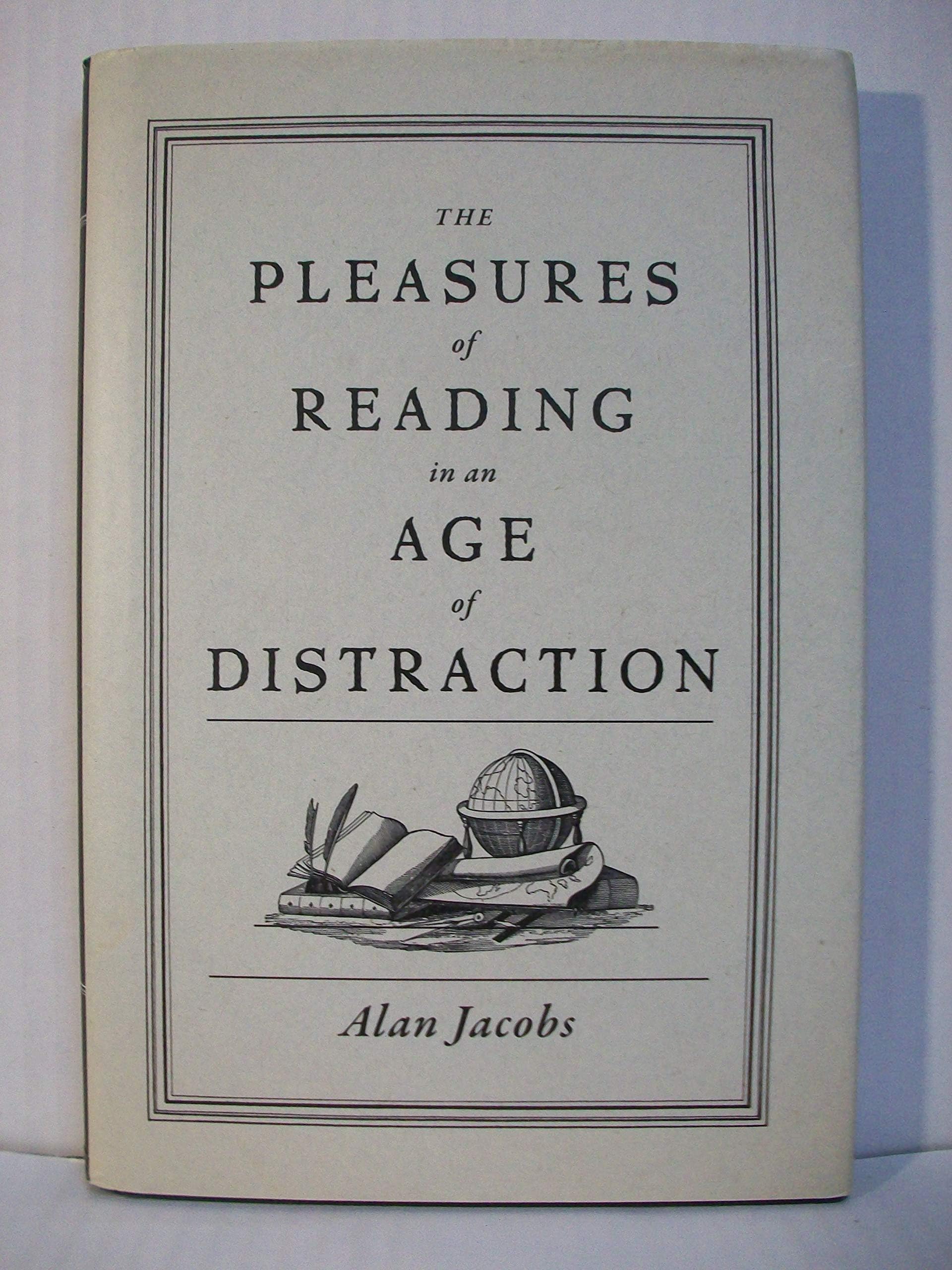
The Pleasures of Reading in an Age of Distraction
Product ID: 8511797
Buy anything from 5,000+ international stores. One checkout price. No surprise fees. Join 2M+ shoppers on Desertcart.
Desertcart purchases this item on your behalf and handles shipping, customs, and support to Lithuania.
In recent years, cultural commentators have sounded the alarm about the dire state of reading in America. Americans are not reading enough, they say, or reading the right books, in the right way. In this book, Alan Jacobs argues that, contrary to the doomsayers, reading is alive and well in America. There are millions of devoted readers supporting hundreds of enormous bookstores and online booksellers. Oprah's Book Club is hugely influential, and a recent NEA survey reveals an actual uptick in the reading of literary fiction. Jacobs's interactions with his students and the readers of his own books, however, suggest that many readers lack confidence; they wonder whether they are reading well, with proper focus and attentiveness, with due discretion and discernment. Many have absorbed the puritanical message that reading is, first and foremost, good for you--the intellectual equivalent of eating your Brussels sprouts. For such people, indeed for all readers, Jacobs offers some simple, powerful, and much needed advice: read at whim, read what gives you delight, and do so without shame, whether it be Stephen King or the King James Version of the Bible. In contrast to the more methodical approach of Mortimer Adler's classic How to Read a Book (1940), Jacobs offers an insightful, accessible, and playfully irreverent guide for aspiring readers. Each chapter focuses on one aspect of approaching literary fiction, poetry, or nonfiction, and the book explores everything from the invention of silent reading, reading responsively, rereading, and reading on electronic devices. Invitingly written, with equal measures of wit and erudition, The Pleasures of Reading in an Age of Distraction will appeal to all readers, whether they be novices looking for direction or old hands seeking to recapture the pleasures of reading they first experienced as children. Review: A Natural Worshiper of Serendipity and Whim - Alan Jacobs, who readers of my blog (nearearthobject-dot-net) may know from previous references to his excellent blog TextPatterns, has recently released a wonderful book about reading that I simply can't recommend highly enough. The Pleasures of Reading in an Age of Distraction is just the sort of pithy, sympathetic tract that our times demand -- it encourages bibliographic exploration, celebrates chance literary encounters, while offering sincere understanding for the would-be "well-read" among us who fear missing out on an overly massive menu of "great works." Those chance literary encounters are the subject of this passage, which I found so delightful and even moving, that I thought I'd share it here. "The cultivation of serendipity is an option for anyone, but for people living in conditions of prosperity and security and informational richness it is something vital. To practice "accidental sagacity" is to recognize that I don't really know where I am going, even if I like to think I do, or think Google does; that if I know what I am looking for, I do not therefore know what I need; that I am not master of my destiny and captain of my fate; that it is probably a very good thing that I am not master of my destiny and captain of my fate. An accidental sagacity may be the form of wisdom I most need, but am least likely to find without eager pursuit. Moreover, serendipity is the near relation of Whim; each stands against the Plan. Plan once appealed to me, but I have grown to be a natural worshiper of Serendipity and Whim; I can try to serve other gods, but my heart is never in it. I truly think I would rather read an indifferent book on a lark than a fine one according to schedule and plan. And why not? After all, once upon a time we chose none of our reading: it all came to us unbidden, unanticipated, unknown, and from the hand of someone who loved us." As the daddy of a toddler who absolutely loves to be read to, this strikes a chord. Jacobs reminds us that just as we trusted our parents to bring the world of words to us when we could not yet even speak sentences, so we can, as adults, allow the myriad chaotic forces around us to drop texts in our path, and accept them as they come, rather than worry over the time not spent on things we feel we are "supposed to" read. Jacobs, incidentally, also confirms my feelings about the benefits of dedicated ereaders such as the Kindle. Particularly at this time in our technological lives when so many other gizmos promise to inundate us with all manner of simultaneous stimuli, Jacobs recognizes that this gizmo can help to cleanse the palate and provide oasis. ". . . people who know what it is like to be lost in a book, who value that experience, but who have misplaced it . . . They're the ones who need help, and want it, and are prepared to receive it. I had become one of those people myself, or was well on my way to it, when I was rescued through the novelty of reading on a Kindle. My hyper-attentive habits were alienating me further and further from the much older and (one would have thought) more firmly established habits of deep attention. I was rapidly becoming a victim of my own mind's plasticity, until a new technology helped me to remember how to do something that for years had been instinctive, unconscious, natural. I don't know whether an adult who has never practiced deep attention--who has never seriously read for information or for understanding, or even for delight--can learn how. But I'm confident that anyone who has ever had this facility can recover it: they just have to want that recovery enough to make sacrifices for it, something they will only do if they can vividly recall what that experience was like." So beyond Jacobs' excellent prose and insight, perhaps one of the things that recommends this book to me so strongly is validation. I can live with that. See more by me at nearearthobject-dot-net Review: A pleasurably distracting read - Alan Jacobs is an academic who teaches literature, so is aware that to some degree in this book he is preaching to the converted. The group he aims to interest is people who like to read but who find themselves distracted by all the time-consuming and often mind-numbing diversions that modern technology provides. If you have ever sat at lunch talking to someone who is twiddling on their tablet or texting on their mobile, you will know exactly what the distractions are and how annoying (and tempting) they can be. Jacobs distinguishes two kinds of reading: deep attention and hyper attention. The former is where we maintain a sustained focus on a book and is most suited to situations where we are looking to intensify our understanding or to lose ourselves in enjoyment. Hyper attention is characterised by skimming and looking at the structure of a book, and is more suited to reading where the primary goal is to glean information. The two are not mutually exclusive: often we use hyper reading in order to select things for deep attention, and Jacobs argues that our education system needs to teach both modes in order to improve our skills in deciding which one to apply to any given text. Being able to decide what to read and how you will read it gives us a greater measure of control over our lives. Jacobs warns against being seduced by lists of worthy books to read or an established canon of literature. There is an extraordinary diversity of books out there, so we need to become self-confident navigators rather than steerage class passengers being fed pap by the `experts'. Jacobs's principle is to `read at Whim' (with a capital W), which is not just random reading, but making informed choices along the way. The book provides some tips on how to improve our deep attention when reading, and how to balance this with hyper attention in order to choose our reading more thoughtfully. Jacobs is rightly scornful of the concept of `multi-tasking', which is generally an excuse for not doing anything properly. Jacobs is a proponent of highlighting, underlining and annotating books, though he appreciates that this might cause problems if you borrow your books from a public library (still, he doesn't hold library books to be sacrosanct). E-readers allow extensive annotations, highlighting and bookmarking, and even sharing of your highlights with others, but Jacobs notes that the system is not yet a match for annotations on paper. His own experience with an e-reader is that it has increased the amount of deep attention reading he has been doing. He puts this down to the fact that accessing distractions on his e-reader is clumsy and takes too much time. I have found the same thing since buying an e-reader, becoming more regularly absorbed in books for much longer periods, though I cannot put my finger on the reasons for this. It is counter-intuitive to what we expect from modern technology, but a pleasing result. Many people re-read books, sometimes on a regular basis or sometimes after an interval of many years. This can be a useful learning experience, to see how our reactions change over time and to see how our judgement of a book can vary depending on our circumstances and accumulated experiences. As I get older I have appreciated books that left me cold in my youth, and others that stirred my imagination now seem shallow and uninspiring. Others, of course, retain their magic and can open up ever new perspectives each time they are read. In the closing section of his book, Jacobs describes the act of reading to a child as an act of love, and a pleasurable experience with books when young is likely to build a love of reading in the longer term. But reading is not an innate skill like language and speech. The part of the brain used for reading is quite different to that used for other language functions. It is certainly a rewarding skill to learn, and Jacobs has written a short but appealing book that will hopefully reignite people's interest in reading more wisely and more often.
| Best Sellers Rank | #240,652 in Books ( See Top 100 in Books ) #131 in General Books & Reading #193 in Literature #20,093 in Self-Help (Books) |
| Customer Reviews | 4.4 out of 5 stars 293 Reviews |
P**P
A Natural Worshiper of Serendipity and Whim
Alan Jacobs, who readers of my blog (nearearthobject-dot-net) may know from previous references to his excellent blog TextPatterns, has recently released a wonderful book about reading that I simply can't recommend highly enough. The Pleasures of Reading in an Age of Distraction is just the sort of pithy, sympathetic tract that our times demand -- it encourages bibliographic exploration, celebrates chance literary encounters, while offering sincere understanding for the would-be "well-read" among us who fear missing out on an overly massive menu of "great works." Those chance literary encounters are the subject of this passage, which I found so delightful and even moving, that I thought I'd share it here. "The cultivation of serendipity is an option for anyone, but for people living in conditions of prosperity and security and informational richness it is something vital. To practice "accidental sagacity" is to recognize that I don't really know where I am going, even if I like to think I do, or think Google does; that if I know what I am looking for, I do not therefore know what I need; that I am not master of my destiny and captain of my fate; that it is probably a very good thing that I am not master of my destiny and captain of my fate. An accidental sagacity may be the form of wisdom I most need, but am least likely to find without eager pursuit. Moreover, serendipity is the near relation of Whim; each stands against the Plan. Plan once appealed to me, but I have grown to be a natural worshiper of Serendipity and Whim; I can try to serve other gods, but my heart is never in it. I truly think I would rather read an indifferent book on a lark than a fine one according to schedule and plan. And why not? After all, once upon a time we chose none of our reading: it all came to us unbidden, unanticipated, unknown, and from the hand of someone who loved us." As the daddy of a toddler who absolutely loves to be read to, this strikes a chord. Jacobs reminds us that just as we trusted our parents to bring the world of words to us when we could not yet even speak sentences, so we can, as adults, allow the myriad chaotic forces around us to drop texts in our path, and accept them as they come, rather than worry over the time not spent on things we feel we are "supposed to" read. Jacobs, incidentally, also confirms my feelings about the benefits of dedicated ereaders such as the Kindle. Particularly at this time in our technological lives when so many other gizmos promise to inundate us with all manner of simultaneous stimuli, Jacobs recognizes that this gizmo can help to cleanse the palate and provide oasis. ". . . people who know what it is like to be lost in a book, who value that experience, but who have misplaced it . . . They're the ones who need help, and want it, and are prepared to receive it. I had become one of those people myself, or was well on my way to it, when I was rescued through the novelty of reading on a Kindle. My hyper-attentive habits were alienating me further and further from the much older and (one would have thought) more firmly established habits of deep attention. I was rapidly becoming a victim of my own mind's plasticity, until a new technology helped me to remember how to do something that for years had been instinctive, unconscious, natural. I don't know whether an adult who has never practiced deep attention--who has never seriously read for information or for understanding, or even for delight--can learn how. But I'm confident that anyone who has ever had this facility can recover it: they just have to want that recovery enough to make sacrifices for it, something they will only do if they can vividly recall what that experience was like." So beyond Jacobs' excellent prose and insight, perhaps one of the things that recommends this book to me so strongly is validation. I can live with that. See more by me at nearearthobject-dot-net
A**N
A pleasurably distracting read
Alan Jacobs is an academic who teaches literature, so is aware that to some degree in this book he is preaching to the converted. The group he aims to interest is people who like to read but who find themselves distracted by all the time-consuming and often mind-numbing diversions that modern technology provides. If you have ever sat at lunch talking to someone who is twiddling on their tablet or texting on their mobile, you will know exactly what the distractions are and how annoying (and tempting) they can be. Jacobs distinguishes two kinds of reading: deep attention and hyper attention. The former is where we maintain a sustained focus on a book and is most suited to situations where we are looking to intensify our understanding or to lose ourselves in enjoyment. Hyper attention is characterised by skimming and looking at the structure of a book, and is more suited to reading where the primary goal is to glean information. The two are not mutually exclusive: often we use hyper reading in order to select things for deep attention, and Jacobs argues that our education system needs to teach both modes in order to improve our skills in deciding which one to apply to any given text. Being able to decide what to read and how you will read it gives us a greater measure of control over our lives. Jacobs warns against being seduced by lists of worthy books to read or an established canon of literature. There is an extraordinary diversity of books out there, so we need to become self-confident navigators rather than steerage class passengers being fed pap by the `experts'. Jacobs's principle is to `read at Whim' (with a capital W), which is not just random reading, but making informed choices along the way. The book provides some tips on how to improve our deep attention when reading, and how to balance this with hyper attention in order to choose our reading more thoughtfully. Jacobs is rightly scornful of the concept of `multi-tasking', which is generally an excuse for not doing anything properly. Jacobs is a proponent of highlighting, underlining and annotating books, though he appreciates that this might cause problems if you borrow your books from a public library (still, he doesn't hold library books to be sacrosanct). E-readers allow extensive annotations, highlighting and bookmarking, and even sharing of your highlights with others, but Jacobs notes that the system is not yet a match for annotations on paper. His own experience with an e-reader is that it has increased the amount of deep attention reading he has been doing. He puts this down to the fact that accessing distractions on his e-reader is clumsy and takes too much time. I have found the same thing since buying an e-reader, becoming more regularly absorbed in books for much longer periods, though I cannot put my finger on the reasons for this. It is counter-intuitive to what we expect from modern technology, but a pleasing result. Many people re-read books, sometimes on a regular basis or sometimes after an interval of many years. This can be a useful learning experience, to see how our reactions change over time and to see how our judgement of a book can vary depending on our circumstances and accumulated experiences. As I get older I have appreciated books that left me cold in my youth, and others that stirred my imagination now seem shallow and uninspiring. Others, of course, retain their magic and can open up ever new perspectives each time they are read. In the closing section of his book, Jacobs describes the act of reading to a child as an act of love, and a pleasurable experience with books when young is likely to build a love of reading in the longer term. But reading is not an innate skill like language and speech. The part of the brain used for reading is quite different to that used for other language functions. It is certainly a rewarding skill to learn, and Jacobs has written a short but appealing book that will hopefully reignite people's interest in reading more wisely and more often.
S**S
A Delightful Celebration of Reading
I serendipitously stumbled across this book as I was shopping on Amazon's Kindle Store. I thought to myself, "A book about why reading is awesome? Sounds like fun!" So I fell prey to that diabolical temptation, the "Buy with One Click" button. That was yesterday. Despite the fact that I have three books open right now, I thought, "I'll read the first couple of pages." And here I am today, and the book is done. It's short and exceedingly readable, but so wonderful in a lot of ways. As a 40-something person, I'm at that place in life where I think about all the books I've yet to read, and that if I'm lucky I'm halfway through my lifespan. Still, it has occurred to me that I'd best get a whole lot more serious about reading books that are important for me to read! So I've been planning out which books I need to tackle. In waltzes Prof. Jacobs and urgently begs me to forget about any such madness. It's a rare and amazing thing that a Professor of English Literature would give me this crucial advice: Read at Whim! Read at Whim! He argues that if reading becomes a duty or a thing to get over with, it becomes soul-killing and empty. I keep unconsciously relating "important books" with my educational career: Hurry up! Get these things read now, before someone finds out what a hack you are! You need to be able to tell people you've read these books, or you'll be an intellectual laughingstock! Jacobs' playful (and I think more than half-serious) suggestion: LIE! Find enough information on these "important" books from the internet that you can evince some basic level of familiarity with them, throw in a couple of knowing comments to your friends....and get back to spending the bulk of your leisure time reading books in which you can truly delight. Get lost in them, experiencing the matchless pleasure that comes with it! This is because in order to truly benefit from any book, you have to take it on its own terms and truly love it for its own sake. By no means should this be taken to construe that Prof. Jacobs advocates reading nothing but brain-candy novels (though he staunchly defends the worth of such reading!). Remember: he's a literature professor, after all. He is driving at the point that you can get the full benefit of a book only when you are ready to receive what it has for you. If you're not ready to receive Tolstoy right now, revel in J.K. Rowling! (though Rowling isn't my cup of tea, personally). As you learn to delight in reading, you will find yourself ready to receive more of the "important" books, and in not in the manner of flogging yourself until you march through a torturous tome. Instead, you will increasingly be able to identify the truly delightful elements of a book that you have never seen before. What seems to lie at the heart of all this is to develop one's capacity for "deep attention." This is a way of reading that is rare indeed...all the more endangered by a world driven to insane levels of A.D.D. by digital, social media, and musical distractions. Deep reading is the sort practiced by medieval monks: reading slowly, deliberately...meditating and ruminating on the wise counsel brought to you by excellent books. It takes discipline over time to develop the silence and focused attention that such excellent works require. Obviously, it doesn't take great mental discipline to read a Tom Clancy novel (now THERE'S an author who is right up my alley)...but the good news is that any form of enjoyable long-form reading can help you develop the focused attention over time that will make bring you to the place where you ARE ready to receive the riches in a truly "great" piece of literature. Jacobs discusses so many intriguing topics in this little book, including the radical idea that our current educational system does NOT provide fertile opportunities to develop this essential "deep attention." Instead it is structured to foster "hyper attention," which is quick scanning to gather information. Ironically, even literature classes do little to develop a deep love of books, because they are time-limited and require exams, essays and papers. In other words, they cannot help but to turn reading into an information-compiling exercise. Now, Jacobs acknowledges the validity of "hyper attention" (quick reading for information-- and indeed many pursuits require just that skill. However, it is impossible to experience the true joys of reading until we discipline our minds to be silent, block out interruptions, slow down, and soak in excellent books. The good news is, those different modes of thinking need not be mutually exclusive! I got a great deal out of this little book. I cannot help but believe that we would benefit as a society I rich ways by Jacobs' exhortations to silence, solitude, meditation, focus. We needn't become Luddites, throwing way our iPads and smart phones. However, truly great ideas come out of minds that can focus attention and think deeply!
G**Y
In short, is a pleasure – if you love to read.
The Pleasures of Reading in an Age of Distraction by Alan Jacobs (Oxford: Oxford University Press, 2011), 162 pp., hard $19.95. The Pleasures of Reading, in short, is a pleasure – if you love to read. Alan Jacobs is a professor of English at Wheaton College, and this book obviously flows out of his passion for literature, but he takes a different approach to reading from that of many others. Where Mortimer Adler, in his classic How to Read a Book, offers a methodical method of reading and provides a list of “must read” books, and Nicholas Carr’s more recent The Shallows laments that few are reading books and even he is losing his ability to do so (p. 104), Jacobs breaks stride and suggests reading at “whim.” Rather than agonizing over reading the classics or reading quickly, or reading for information and out of necessity, he suggests we read what we want to read—that which gives us pleasure and joy (pp. 13-25). The overarching principle for reading is “Whim”— read for delight (p. 23). But the author goes further and distinguishes whim from Whim. He defines whim as “thoughtless, directionless preference that almost invariably leads to boredom or frustration or both. But Whim is something very different: it can guide us because it is based in self-knowledge” (p. 41). With Whim the books that delight others need not delight us, nor should we feel obligated to be delighted. Instead, based on our own interest, we are free to enjoy the literature that we appreciate. Jacobs acknowledges that not everyone has the ability for deep attention reading, which has always been a minority pursuit (p. 106). The extreme reader, he writes, is a rare bird—born, not made (p. 107). He is uncertain that an adult who has never practiced deep attention can learn how. But he is confident that anyone who once had this faculty can recover it (p. 116). It is for such people that he writes this The Pleasures of Reading (p. 108). Along the way, Jacobs offers excellent advice for reading at Whim. While reading, as such, does not make anyone a better person (pp. 52-53), it provides many benefits when done according to Whim. Start by reading slowly and disregard speed reading (pp. 67-78). Mark most books (not novels) to foster retention and for reference (pp. 57-61). Since people have always struggled with distractions and the ability to concentrate (p. 90) he recommends seeking out solitude and developing a cone of silence (p. 117). Using other devices such as a Kindle (pp. 61-67, 81-82) might also reduce distractions. Since leisure activity is largely a retreat to the imagination, reading becomes the perfect leisure activity (p. 122), partly because “the point of books is to combat loneliness” (p. 135). Also, the act of read to others is associated with being loved, especially by children (p. 146). The Pleasures of Reading is creatively structured. There are no table of contents, no chapters (just highlighted subpoints), no normal footnotes (but references in “An Essay on Sources” that concludes the book), and no indexes of any kind. And while this is creative, it is frustrating if the reader is trying to return to a particular subject. I found this design more distracting than helpful. On the other hand, I thoroughly enjoyed the book, probably because I resonate with these words, “…when the reason for our raptness is sheer and unmotivated delight. This is what makes ‘readers’ as opposed to ‘people who read.’ To be lost in a book is genuinely addictive: someone who has had it a few times wants it again.” Reviewed by Gary E. Gilley, Pastor-teacher at Southern View Chapel
J**S
You cannot judge a book by it's cover!
I had intended to read this a year or two ago but only got a copy last year and, in the great scheme of things began to read it last week. Having finished the book, I am not sure that this was the book I wanted to read. As far as I was concerned when I purchased it, the subject matter was dealing with the benefits of reading when there are so many distractions in the world. Having come to the conclusion, I find that this is not what the book is actually about and is in fact, a different animal altogether. Indeed, I am greatly perplexed by the contents. Let me elaborate in the sentences below, But first, let me deal with a volume which is mentioned several times throughout the text, is Rose "The Intellectual Life of the British Working Classes". I wholeheartedly endorse the appreciation of that work although I came to it from a different direction. The official history of England uses a demarcation date of 1870 to set out when education was instituted for children. In fact the year celebrates the nationalization of existing private education for the majority of children in England and Wales at least, paid for by the hard earned pennies of workers who wanted their children to do better than their parents. This was explored by E.G. West and his work supplement by D.G. Green's work on the organization of working class groups and welfare societies in both England and Wales in Australia. There is a strong tradition in Northern England and Wales in particular of reading for oneself which continues in Labour voting areas. I digress. The author takes us on a journey about reading, and essentially sets out a correct way to read without the distractions which plague the contemporary landscape. I get particularly incensed by those who write in text speak and who communicate by facebook and twitter sized sentences. Yet, at the same time, I recognize that the world has changed and particularly so in education. I am very grateful to the author for getting me all riled up by what he has written. As I see it, the process of reading some things in a quiet part of a university library holds many attractions but this cannot be the way to interact with all books. As a small boy I read British comic books with few pictures and lots of words. By the time I was seven I took up the challenge of the worlds classics which I borrowed frequently from Southwick Library in Sunderland. Later I expanded my field to include anything and everything including the lyrics of Bob Dylan at school. This is not about me though. I see reflections of myself at varying ages within this book and yet none of the pen portraits match with my experience. At my more advanced age, I no longer read novels and can count of the fingers of one hand how many I have read in over 10 years. I read all the time, journal articles mainly and non-fiction books in many fields and this is my point of departure. I have no claim to expertise in the field of fiction, save to recite my own experiences where a particular story has opened up other vistas of my thought. But in the main, I remain unconvinced of the case the author makes out. In my field, much is published but little adds significantly to existing knowledge save for nuance and the establishment of contested fields over minor details. I also tend to read over a range of subjects where I have some interest or where I am following a line of enquiry outside of disciplinary boundaries. These readings will often offer a new way of looking at something in my field or suggest connections. Sometimes it is though a window opens and the son shines though with unexpected realisations. Those moments are, alas, only too rare. Reading is a personal experience, there is no right or wrong in how one does it, For me the interaction and struggle with the text is the fun and joy of reading. I have found through repeated readings of some texts, one can achieve different perspectives which the current author alludes to such as the impact that experience brings to bear on our capacity to understand a text or to try and find meaning in the surrounding culture which existed at the time of the setting of the book. All I am trying to say is that reading provides a broader, deeper and more colourful canvas for our lives that is not provided for by other media choices. I would dare to suggest that any reading which has any impact on the being of the reader which enhances or adds to their life experiences is of inestimable value and we should encourage other to grapple with texts, challenging them at every stage in order to better the human condition. By way of conclusion, I would love to see a further book from this author chronicling the pleasure of reading in the age of distraction.
S**P
A pleasure to read
Growing up in a conservative Christian home, I was taught that fiction was a waste of time and that I should be very careful about what I read so that I wouldn't be seduced by error. I'm grateful that I completely ignored both of those rules. However, I used to read for information and, although I was a voracious reader and enjoyed reading, underlying my reading was always an instrumental assumption that I could use what I learned to advise others or make myself a better person. I also tend to be a person that likes to be organised in my reading - I keep lists of books I want to read and, until recently, I tended to read the next one on the list. It was difficult for me to just "randomly" pick something to read just for pleasure and just because it was of interest at the moment. And I also felt that, at some time in my life, I really needed to read all the "classics" or "great books" in the Western "canon". Apparently, I am not alone. According to Alan Jacobs in his delightful book The Pleasures of Reading in an Age of Distraction these types of approaches to "responsible" reading are widespread and part of the way we have been educated to read. But Jacobs will have none of it! He brings a breath of fresh air to reading that lifts any burden we might feel and, instead, recommends we read what we find pleasurable - without shame! The Pleasures of Reading in an Age of Distraction is a meditative reflection on reading that avoids telling the reader what they should read. No rules here other than some guidelines about gaining the most from reading. Instead, we are to read at Whim. He writes: '... my commitment to one dominant, overarching definitive principle for reading: Read at Whim' (italics in original). 'Read what gives you delight - at least most of the time - and do so without shame.' Jacobs is not suggesting that we do not sometimes read the so-called "great books" that require us to commit to a demanding read. But he likens those to what we might eat at an elegant restaurant - we eat sometimes but not every day. Reading at Whim cannot be the only reason we read. But it is a type of reading we need to recover. Jacobs does distinguish between lower-case whim and upper-case Whim. The lower-case version '...is thoughtless, directionless preference that almost leads to boredom or frustration or both. But Whim is something very different: it can guide us because it is based in self-knowledge.' Jacobs explores the difference between the two using examples from literature - demonstrating a vast richness of ancient and contemporary sources. The idea that we can read at Whim is liberating! This book has already changed the way I read. He embraces new technologies (he has a fascinating discussion of the benefits of reading with a Kindle compared to a traditional book) and iconoclastically sweeps away a whole lot tired assumptions that make reading so burdensome for many people. So... if you want to consider a new approach to reading that has the potential to enliven it again for you, then check out this excellent, Whimsical little book.
M**N
Down With the Plan!
With this short, enjoyable book, Alan Jacobs is eloquently preaching to the choir—those who are already readers, who understand the joy, the diversion, the absorption, even the obsession that can come from reading. His extended essay, divided into pithily-named sections rather than chapters, ranges across literary genres and experiences of reading, but several crystalline points emerge from the amusing anecdotes, erudite discussion, and apt quotations. One is that far too many people “want not to read but to have read” (p. 72). For them, reading is a matter of ticking boxes on a “to read” list, rather than savoring what they are reading, letting it work its way into their consciousness and their emotions, taking as long as they want, reading slowly rather than rushing to get to the end. This is connected to the twin tendencies to either look to authorities for advice on what to read, or to see reading as primarily a means for self-improvement, a form of what C. S. Lewis (quoted by Jacobs) called “social and ethical hygiene.” This would be along the lines of “eat your vegetables because they’re good for you,” as opposed to “try these vegetables, they’re delicious.” Connected to this tendency, of course, is a particularly bookish form of that pervasive modern American phobia: FOMO (Fear Of Missing Out). What If there is something I’m “supposed to” read, but I haven’t read it—or, worse, haven’t even heard of it? Does that make me a Philistine? This anxious tendency is on the rise, it seems, thanks to a cottage industry in books giving advice on reading that ranges from the breathless to the learned, and to “must read” lists of which any number can be found instantly with a simple internet search. A certain amount of humility and "memento mori" is also required. None of us (or at least no one who is likely to read this book) is likely to read every book he or she would like to before dying. There will always be things left on the shelf, on the pile, on the nightstand. Well, maybe not for critic Harold Bloom, he of the reputed 1000-pages-per-hour reading speed. But as part of his general dismissal of what might be called the Prescriptivists (or what Lewis called “the Vigilant school”), Jacobs puts paid to the right of Bloom or anyone else to tell you or me which authors we should read. What about the sheer joy of reading? Jacobs points out that this doesn’t necessarily come with speed. It requires openness to whatever the book has to offer, and to the possibility (which one should hope for) of a completely unexpected experience, probably unique to each individual. Regrettably, students too often have the joy of reading taught right out of them in school, and this can easily taint their appreciation of reading for life. Reading, Jacobs argues, must be “extricate[d] . . . from academic expectations” (p. 115). Note that this is being said by a literature professor (formerly at Wheaton College, now at Baylor University). And lest anyone think that Jacobs shuns technology in favor of the traditional sensual comforts of bound books, he notes that it was actually the purchase of a Kindle that to some degree rescued sustained, deep-concentration reading for him. I remain dedicated to the bound versions of books myself, but this is really a matter of personal preference rather than Ludditism. I am inextricably linked to technology in other ways. To those who complain that information technology and electronic entertainment have created a generation (multiple generations, really, not just the “digital natives”) unable to concentrate for more than a minute at a time, flitting from one stimulus (including bound books) to the next like a hummingbird seeking nectar, Jacobs quotes with approval Clay Shirky, who said that the problem is not information overload, but “filter failure,” an inability to be disciplined and selective. That sounds right to me. One of the primary purposes of the book is to debunk not the idea of literary canons as such, but the notion that the individual reader must follow a plan, a program, a road map, a syllabus, or a sense of obligation in choosing what to read. When it comes to the best principle of selection, Jacobs summarizes his advice in a single word: Whim. Read what you want!
J**E
A Genuine Pleasure
"...nonreaders outnumber us--always have and always will--but we can always find one another and are always eager to welcome others into the fold. May our tribe increase." Amen! I loved this brilliant book. I freely admit that it is mostly because I am a lifelong member of the tribe of readers, but also because this is just a lovingly written and timely book. When I picked this up I expected a diatribe of all that is wrong with our social media, give it to me in tiny chunks or I am not interested, kind of culture and a list of all the ways that reading is in peril. That is not at all what I found, much to my delight. Jacobs has written a book that explores the true, bone deep, pleasure of reading. In fact, he denounces many of the seeming paragons of intellectualism that proclaim lovers of Harry Potter are "sub-literate" or that there is a list of books you simply "must" read if you want to consider yourself well-read. In contrast to these, Jacobs is an evangelist for reading "at whim". "Read what you want!" He proclaims. "And feel no shame in it!" He does, however, argue for balance--no, not so much balance--he argues for a broadening of one's literary tastes, so that our whim can extend to the greater works of literature. In other words, one cannot eat junk food all the time and expect to be healthy, but one also should not try to consume a gourmet meal three times a day either. There is room for both to be enjoyed. And that's really his point, over and over again, reading should be enjoyable. That doesn't mean it will always be easy, but it should always be a pleasure. The author obviously thinks deeply on this subject and has a genuine love for books and reading and language. He is a professor of literature, and I have no doubt, would be a favorite of mine had I been his student. I found myself encouraged but also challenged in my own reading through this book. Specifically, I was challenged to re-read. Rather than power through volume after volume like a child screaming "look what I can do" as he shows off for the adults in the room, I should take the time to revisit books again and again. I confess, I don't do this as often as I should. Now, thanks to Jacobs, I want to. I see the genuine value in doing so. More importantly, I see the "pleasure" in doing so. I don't think this book would necessarily speak to everyone, but it certainly spoke to me and per the author's advice, I will come back to this book again.
M**.
Five Stars
Good value!
H**L
Wie wir uns die Fähigkeit des vertieften, genussvollen Langzeit-Lesens wieder aneignen
Der US-amerikanische Professor für englische Literatur, Alan Jacobs hat dieses Buch im Stile von „Plaudereien in meinem Studierzimmer“ (oder sage ich besser „auf meinem Blog“) gehalten. Er spaziert mit Freude und Humor durch seine eigene Biografie als Leser. Nicht dass er eine chronologische Analyse vornimmt, bewahre. Gerade diese analytische Art ist ihm sehr zuwider. Er will den Anspruch an das Lesen entkrampfen. Nichts ist ihm ein grösserer Greuel (so scheint es zumindest), als ein verbissenes Sich-durch-eine-Leseliste-der-100-wichtigsten-Bücher-Kämpfen. Man tritt dann nämlich mit dem Anspruch an, durch das Lesen gebildet, also im Effekt ein besserer Mensch zu werden. Dieser Anspruch ist utopisch und verkehrt. Jacobs Hauptthese lautet: Lese als oder mit WHIM. Damit ist eine freudiger, in die Welt eines Buches eintauchender, reflektierend antwortender Zugang zum Lesen gemeint. Ironischerweise gewann der Autor diesen Zugang durch sein elektronisches Lesegerät zurück. Er liess sich nicht mehr durch ständig eingehende Nachrichten (200 RSS-Feeds!) stören, sondern widmete sich wieder ungestört dem Genuss des sich-ungestört-durch-einen-Text-pflügen. Tatsächlich wird Jacobs etwas kulturkritisch – trotz allem Dagegenstemmen. Er bemängelt die verlorene gegangene Fähigkeit des anhaltenden, vertieften Langzeit-Lesens. Er propagiert Lesen für jedermann, gibt jedoch im Verlauf seiner Betrachtung unumwunden zu, dass es höchstens einige Prozent der Bevölkerung betreffen würde. Wir sollten also aufhören, uns von Experten vorschreiben zu lassen, was wir in welcher Geschwindigkeit mit welchem Ertrag lesen sollten. Das Lesen sollte von der akademischen Welt abgekoppelt und in die Welt des Alltags zurück verpflanzt werden. Lies, was dir gefällt, und das überwiegend und ohne Scham (15+23). Lies, was das Zeug hält. Lies fürs Leben. Lies, was du lessen willst, in deiner eigenen Geschwindigkeit. Daneben flechtet Jacobs ein, welch erstaunliche Hirnleistung das Lesen darstellt. Ich nehme drei Hinweise aus dem Buch mit: Lesen heisst antworten. Das bedeutet nicht in jedem Fall mit Stift und Tagebuch zu lesen, sondern auch mal ohne Werkzeug, den Text auf sich wirkend und sich hinterfragen lassend. Zweitens komme ich mehr auf den Geschmack, Bücher zum wiederholten Male zur Hand zu nehmen, für einzelne Passagen und insgesamt. Erst so, meint Jacobs, entsteht erst eine „richtige“ Lesegewohnheit. Auch der Rückblick tut gut. Man wächst über die Jahre: Im Rückblick wird man feststellen, dass das, was damals so aufregend neu, über die Jahre integriert worden ist. Die wichtigste Mahnung bleibt jedoch, Bücher nicht um der Seitenzahlen, dem guten Ruf oder der eigenen Bildung willen zu lesen – sondern zur Stärkung der eigenen inneren Landschaft. Fazit: Das waren vergnügliche fünf, sechs Stunden mit dem Lesegerät.
A**R
Love loves it
My baby loved this book ❣️✨
A**Y
A Pleasure to Read in an Age of Distraction
I am someone who has recently rediscovered the joys of reading so was fascinated by this well-written little book. At times I found myself agreeing wholeheartedly with the author but the one thing that I would disagree with him about is the use of lists or books such as 1001 Books to Read Before You Die. When I started reading a lot I found a lot of books that I had never heard of by using these sources & have now built up a very small library so that I can 'read at whim' as Alan Jacobs so wisely suggests. I would strongly recommend this book to anyone who is interested in reading but who sometimes doubts their method or motives - they will certainly find answers & food for thought here.
K**R
Must read
It's worth it
Trustpilot
3 days ago
1 day ago