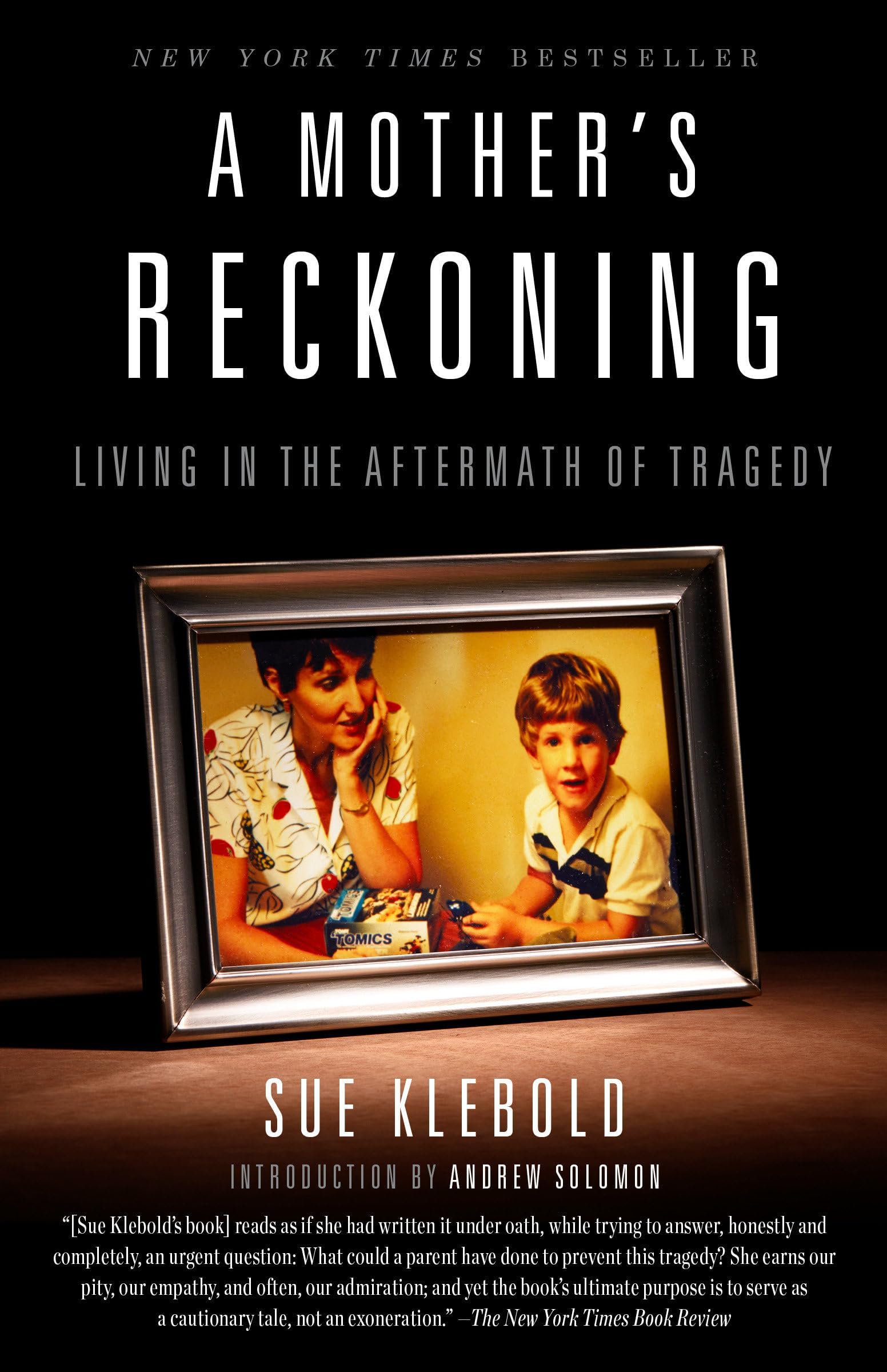
A Mother's Reckoning: Living in the Aftermath of Tragedy
Product ID: 39007728
Buy anything from 5,000+ international stores. One checkout price. No surprise fees. Join 2M+ shoppers on Desertcart.
Desertcart purchases this item on your behalf and handles shipping, customs, and support to Lithuania.
The acclaimed New York Times bestseller by Sue Klebold, mother of one of the Columbine shooters, about living in the aftermath of Columbine. On April 20, 1999, Eric Harris and Dylan Klebold walked into Columbine High School in Littleton, Colorado. Over the course of minutes, they would kill twelve students and a teacher and wound twenty-four others before taking their own lives. For the last sixteen years, Sue Klebold, Dylan’s mother, has lived with the indescribable grief and shame of that day. How could her child, the promising young man she had loved and raised, be responsible for such horror? And how, as his mother, had she not known something was wrong? Were there subtle signs she had missed? What, if anything, could she have done differently? These are questions that Klebold has grappled with every day since the Columbine tragedy. In A Mother’s Reckoning , she chronicles with unflinching honesty her journey as a mother trying to come to terms with the incomprehensible. In the hope that the insights and understanding she has gained may help other families recognize when a child is in distress, she tells her story in full, drawing upon her personal journals, the videos and writings that Dylan left behind, and on countless interviews with mental health experts. Filled with hard-won wisdom and compassion, A Mother’s Reckoning is a powerful and haunting book that sheds light on one of the most pressing issues of our time. And with fresh wounds from the Newtown and Charleston shootings, never has the need for understanding been more urgent. All author profits from the book will be donated to research and to charitable organizations focusing on mental health issues. — Washington Post , Best Memoirs of 2016 Review: A very difficult book to read ~ A sad story, but one that had to be told - Since so many of the negative reviews for this book state that Sue Klebold wrote it for monetary profit, I would like to set the record straight. The author profits from the book are being donated to research and to charitable foundations focusing on mental health issues. I think it's important that people know this prior to reading the book, as it removes any doubt that Sue Klebold wrote it for purposes other than to tell her side of the story and to educate the public on hidden mental health issues in teenagers. This is the most difficult book to review that I've ever read. I'm giving it 5 stars for the quality of Sue Klebold's writing, but I have to admit that at times while reading it; I was somewhat put off by her constant praising of her son Dylan. With that said; this is an extremely compelling story of a life gone wrong, and the impact that it had on a small town, state, country, and the entire world. I immensely respect the opinions of the author, and fully understand that the story she tells is exactly as she sees it. It's one thing to be the mother of the son of a suicidal mass murderer, and quite another to be a reader who can in no way know the entire background of the story without having actually lived it. This is the story of a mother who loved her son, continues to do so to this day, and through no fault of her own, missed the signals that something was terribly wrong. This is also the story of a woman who cares deeply about the victims, their families and the survivors. While it may appear to casual readers such as myself that she's proselytizing the attributes of her son; she does so knowing that it will offend some people, but more importantly because at least in her eyes, it's the truth as she sees it. While it's written honestly and with a great deal of compassion and empathy; I personally still have trouble coming to terms with the manner in which she writes about her son Dylan. As mentioned above; it's quite different to view this event through my eyes, than those of the author. I'm trying to be as objective as possible and to place myself in a similar situation to hers, but find that impossible to do. After completing the first part of the book; I was upset by her effort to diminish blame for the Columbine tragedy on her son and his accomplice, Eric Harris. I couldn't help from feeling as if Sue Klebold was trying to portray her son as just a slightly troubled teenager, no different than any other teenager that you see everyday. I felt as if the first part of the book delved much too heavily on how wonderful Dylan was, and far too little on the devastating consequences of what he and Eric did. Than again, I ask myself if I would have reacted any differently. As the book progressed, she finally started to address the victims of this horrendous crime. I believe that Sue Klebold was being completely honest throughout the book, but despite her good intentions; I was still left with the feeling that too much time was spent on her trying to absolve herself from guilt, and too little time spent on addressing the fact that there were real warning signs that possibly could have prevented this horrendous calamity. She mentions that both Dylan and Eric were arrested the previous year for breaking into a van. She also mentions that her son wrote a paper that was so graphically disturbing that she and her husband were summoned to the school to learn of its contents. Than, as I continued to read the book; I kept second guessing my own opinions of her. One moment I was viewing her in a very negative way, the next moment I felt total empathy and compassion for Sue Klebold. I kept telling myself that it wasn't my right to question her motives, after all, she's the one who lived through it, not me. To me, there were plenty of warning signs. Obviously, regardless of these signs, no one would ever expect that their child would be capable of committing such an atrocity. Yet, with these warning signs being front and center; it would certainly have been enough for intervention to have taken place. Obviously they weren't, but why not. It's easy for me to say that faced with the same set of signals, I would have reacted differently. Who knows; unless you've lived it first person, how can you know for sure that you would have heeded the warning signs. Teenagers are adept at hiding their feelings, and although many of the same signals play out on a daily basis in homes across America, crimes such as this, don't. While the actions of Dylan Klebold and Eric Harris should be viewed as abominable, the fact that Dylan suffered from hidden depression plays a major role in his behavior. It's nearly impossible for me to be critical of Sue and Tom Klebold, as no one can possibly know what it was really like to be in their shoes, except themselves. Speaking only for myself; I'd like to think that presented with the warning signs mentioned above, I would have intervened. Perhaps I too would have been blindsided, as she says they were. Yes, it's hard for me to imagine such a scenario, but than again, how do I know for sure that I wouldn't have been blindsided too. I most certainly feel incredible empathy for what her family has gone through, but on the other hand, after reading the book; had I been one of the parents of the victims or one of the injured survivors; I would have felt as if she was being somewhat disingenuous in her portrayal of the situation. This is not meant to diminish her portrayal of the way things played out. I honestly believe that Sue Klebold feels as if she was honest and forthright in her appraisal of the situation, but I'm left with the uncomfortable feeling that this book is more about making her feel better, than about addressing the disaster straight on. That is, until I continued reading. It becomes obvious that Sue Klebold is a kind, compassionate person. She is not to blame for what her son did. As atrocious as his and Eric's actions were; they were not the result of bad parenting on the part of the Klebold's. It gives me no pleasure to at times being critical of this book. I think it's nearly impossible to read it without getting upset and shaken to the core. The subject matter is incredibly sad, as is the situation that the Klebold family and all of the victims families are in, and will be for the rest of their lives. Had the book been more oriented on the devastating impact of Dylan's and Eric's despicable actions; I would have finished it feeling that justice had been done to the story. Having completed it; I now realize that it's not possible for justice to be served. Without diminishing the fact that Sue Klebold obviously feels tremendous pain at what her son did; I'm still left feeling as if she spent too much time talking about the virtues of her son. That's when I come to realize that she does so in order to drive home the fact that in most ways he was a normal, loving child. It leaves the reader wondering, if such a loving son, from such a loving family, could commit such a despicable act of violence, couldn't the same thing take place from other loving homes. Everything about this book leaves you wondering, questioning, asking what's right and what's wrong. In the end, there simply are no definitive answers. Toward the middle and end of the book, there's a lot of talk about child suicide and how depression can be masked so well by teenagers. I'm not doubting any of this. What I find troubling is that there's a heavy emphasis throughout the book on Dylan's suicide, but not enough on the homicide that he committed. Granted; Sue Klebold is writing about her son for whom she has unconditional love. I know that I wouldn't have the ability to talk about my own son in such a positive light, had he committed such a horrendous crime. Once again, since I'm not in her situation; it's impossible to know how I would react. I guess what I'm trying to say, is that faced with a similar situation; I believe I would not be able to ever feel unconditional love toward the perpetrator of such a crime, regardless of who it was. My heart would bleed for the victims and the families, at least that's how I think I would react. Sue Klebold does not make excuses for what Dylan did, but she tries to explain that due to his hidden depression, he was suicidal. Once he teamed up with Eric Harris, the suicidal intentions became a carefully planned mass murder, with suicide as the anti-climatic finish. This was a well though out out plan; it's incredibly sad that no one saw it coming. In summary; I come away from reading this book with mixed emotions. The writing is superb, and I do feel as if the author is speaking from her heart. I believe that she's being totally honest when she talks about how much she loved and continues to love her son. I believe that her compassion toward the victims families is genuine and heartfelt. Her extensive coverage of suicide prevention, knowing the signs of depression, etc. is to be commended. I believe her when she says that her family saw no warning signs to the impending disaster. It's just that I want to believe that faced with a similar scenario; I would have been more aware of these signs. While they obviously didn't see them; the warning signs were there. Her son did a terrible thing. This is a no win situation, and regardless of how I feel, nothing will reverse the course of history. I only wish that the author had spent a little less time praising her son, and a little more time coming to terms with the devastation that he caused to so many people. While it was an integral part of the story, I felt as if there was too much time spent talking about the lawsuits against the family. Finally; I know that there were many survivors of the tragedy who will be physically and mentally challenged for the rest of their lives. Some are unable to walk, others have other physical disabilities. All are emotionally scarred for life. Sue Klebold wrote compelling letters to all of the survivors. In addition, she wrote letters to the families of the deceased. These were heartfelt, sincere letters that were extremely difficult for her to write. This is a caring woman who was dealt a horrible blow. The actions of her son can never be forgiven, but to blame her for what her son did is wrong. What he and Eric did is beyond comprehension, but aside from missing signals that any parent could miss, it's not fair to blame the messenger. Yes, I'm still left with the feeling that something could have been done to prevent this tragedy. After reading the book, however, I'm not placing blame on anyone. Placing blame accomplishes nothing, and faced with the exact same set of circumstances, I have no doubt that many people would have done things exactly the same way. I don't think that Sue Klebold is in denial; I actually feel quite the opposite. This book was her sincere effort to explain how her son was raised, and how, despite the loving home he lived in, something went dreadfully wrong. There is no doubt that this kid was loved, no doubt whatsoever. Perhaps had it not been for Eric Harris, this catastrophe may have been averted. It would be nice to hear from the Harris family, but it's unlikely that we will. It does appear that Eric Harris was the lightning rod behind this event, but without additional information, we'll never know for sure. Certainly, both boys are responsible for the carnage. I don't think that it's possible for any of us to truly know all of the answers to this incredibly sad story; we can only move on and learn. I wish the best to Sue Klebold and her family. I especially wish the best to the victims families, and to all of the survivors who are coping with this tragedy every day of their lives. It's difficult to imagine what it's been like for the survivors and for the victims families. April 20, 1999 changed their lives forever. The immense power of empathy is needed for every person affected by this awful event. Hopefully the passage of time will heal. Perhaps forgiveness is the only way to truly survive this unthinkable tragedy. Review: Unflinching Glimpse into Unthinkable Grief - I was a senior in high school in 1999 when the Columbine massacre took place. I remember signing a giant banner to be mailed to Littleton and I struggled with what to write in condolence. I believe I said something to the effect of "May God hold you in His arms." What can one possibly say to people bereaved by loss this horrific? The Columbine tragedy set off a series of copy cat events across our nation. In fact, at my high school graduation in June we did not walk across a stage, because school administrators were rightfully terrified of another "event". My name was called and I walked across the 50 yard line clutching my shiny new diploma. I marched right out of that stadium and into my new life. Throughout my life I've often thought of the victims, denied their own graduation march... they should be graduating HS, graduating college, starting jobs, buying homes, marrying, have children of their own... I've always been haunted by Columbine, it seemed so utterly shocking to me; it is still shocking. It was perhaps the first time I was ever truly rattled by a world event. This felt all too close to home and I had a deep desire to know the unknowable "why". I felt the answer must begin at home with the parents of the perpetrators. I had many questions, paramount among them, how could they not know? How could it be be possible to live with someone horribly depraved and not know? Sue Klebold, mother of Dylan, one of the killers bravely bares her soul in her new memoir "A Mother's Reckoning". In it she describes what she missed, what she would do differently, and how to recognize depression and suicidal thoughts in a loved one. It is a powerful read and I was left humbled. Not only is Ms. Klebold articulate and sincere she has filled these pages with profound insights into mental health issues. It is as honest and open of a memoir as one could ever hope to read. It teaches, using the most devastating first hand account, why we must work to educate ourselves to recognize the signs of depression and suicide. It further teaches why mental health disorders should be destigmatized and treated like we would treat other ailmentents. Sue spares nothing in this unflinching account of her bewilderment, shame, and grief. She has struggled and still struggles to reconcile the loving son she knew with the horrors he caused. This book will open your eyes and shatter preconceived notions about this family. I wish I could take Sue in my arms and hold her. I sincerely hope that she is able to find a measure of peace in bravely sharing her story. In remembering the devestation of Columbine it is easy to forget that Dylan walked into that school wanting to die. When one understands this piece of the puzzle it becomes more plausible to try to grasp the other facets of the tragedy. I believe everyone should read this book. Only when we begin to understand how to treat and diagnose mental health issues can we hope to end the violence that has plagued our nation. This is a book about the enormity of grief, about mental health, the exorbitant tragedy of suicide, and how mental disorders left unchecked can unfurl in tragedy so profound it can haunt a nation.


| Best Sellers Rank | #63,704 in Books ( See Top 100 in Books ) #235 in Murder & Mayhem True Accounts #615 in Memoirs (Books) #710 in Women's Biographies |
| Customer Reviews | 4.5 out of 5 stars 7,196 Reviews |
E**S
A very difficult book to read ~ A sad story, but one that had to be told
Since so many of the negative reviews for this book state that Sue Klebold wrote it for monetary profit, I would like to set the record straight. The author profits from the book are being donated to research and to charitable foundations focusing on mental health issues. I think it's important that people know this prior to reading the book, as it removes any doubt that Sue Klebold wrote it for purposes other than to tell her side of the story and to educate the public on hidden mental health issues in teenagers. This is the most difficult book to review that I've ever read. I'm giving it 5 stars for the quality of Sue Klebold's writing, but I have to admit that at times while reading it; I was somewhat put off by her constant praising of her son Dylan. With that said; this is an extremely compelling story of a life gone wrong, and the impact that it had on a small town, state, country, and the entire world. I immensely respect the opinions of the author, and fully understand that the story she tells is exactly as she sees it. It's one thing to be the mother of the son of a suicidal mass murderer, and quite another to be a reader who can in no way know the entire background of the story without having actually lived it. This is the story of a mother who loved her son, continues to do so to this day, and through no fault of her own, missed the signals that something was terribly wrong. This is also the story of a woman who cares deeply about the victims, their families and the survivors. While it may appear to casual readers such as myself that she's proselytizing the attributes of her son; she does so knowing that it will offend some people, but more importantly because at least in her eyes, it's the truth as she sees it. While it's written honestly and with a great deal of compassion and empathy; I personally still have trouble coming to terms with the manner in which she writes about her son Dylan. As mentioned above; it's quite different to view this event through my eyes, than those of the author. I'm trying to be as objective as possible and to place myself in a similar situation to hers, but find that impossible to do. After completing the first part of the book; I was upset by her effort to diminish blame for the Columbine tragedy on her son and his accomplice, Eric Harris. I couldn't help from feeling as if Sue Klebold was trying to portray her son as just a slightly troubled teenager, no different than any other teenager that you see everyday. I felt as if the first part of the book delved much too heavily on how wonderful Dylan was, and far too little on the devastating consequences of what he and Eric did. Than again, I ask myself if I would have reacted any differently. As the book progressed, she finally started to address the victims of this horrendous crime. I believe that Sue Klebold was being completely honest throughout the book, but despite her good intentions; I was still left with the feeling that too much time was spent on her trying to absolve herself from guilt, and too little time spent on addressing the fact that there were real warning signs that possibly could have prevented this horrendous calamity. She mentions that both Dylan and Eric were arrested the previous year for breaking into a van. She also mentions that her son wrote a paper that was so graphically disturbing that she and her husband were summoned to the school to learn of its contents. Than, as I continued to read the book; I kept second guessing my own opinions of her. One moment I was viewing her in a very negative way, the next moment I felt total empathy and compassion for Sue Klebold. I kept telling myself that it wasn't my right to question her motives, after all, she's the one who lived through it, not me. To me, there were plenty of warning signs. Obviously, regardless of these signs, no one would ever expect that their child would be capable of committing such an atrocity. Yet, with these warning signs being front and center; it would certainly have been enough for intervention to have taken place. Obviously they weren't, but why not. It's easy for me to say that faced with the same set of signals, I would have reacted differently. Who knows; unless you've lived it first person, how can you know for sure that you would have heeded the warning signs. Teenagers are adept at hiding their feelings, and although many of the same signals play out on a daily basis in homes across America, crimes such as this, don't. While the actions of Dylan Klebold and Eric Harris should be viewed as abominable, the fact that Dylan suffered from hidden depression plays a major role in his behavior. It's nearly impossible for me to be critical of Sue and Tom Klebold, as no one can possibly know what it was really like to be in their shoes, except themselves. Speaking only for myself; I'd like to think that presented with the warning signs mentioned above, I would have intervened. Perhaps I too would have been blindsided, as she says they were. Yes, it's hard for me to imagine such a scenario, but than again, how do I know for sure that I wouldn't have been blindsided too. I most certainly feel incredible empathy for what her family has gone through, but on the other hand, after reading the book; had I been one of the parents of the victims or one of the injured survivors; I would have felt as if she was being somewhat disingenuous in her portrayal of the situation. This is not meant to diminish her portrayal of the way things played out. I honestly believe that Sue Klebold feels as if she was honest and forthright in her appraisal of the situation, but I'm left with the uncomfortable feeling that this book is more about making her feel better, than about addressing the disaster straight on. That is, until I continued reading. It becomes obvious that Sue Klebold is a kind, compassionate person. She is not to blame for what her son did. As atrocious as his and Eric's actions were; they were not the result of bad parenting on the part of the Klebold's. It gives me no pleasure to at times being critical of this book. I think it's nearly impossible to read it without getting upset and shaken to the core. The subject matter is incredibly sad, as is the situation that the Klebold family and all of the victims families are in, and will be for the rest of their lives. Had the book been more oriented on the devastating impact of Dylan's and Eric's despicable actions; I would have finished it feeling that justice had been done to the story. Having completed it; I now realize that it's not possible for justice to be served. Without diminishing the fact that Sue Klebold obviously feels tremendous pain at what her son did; I'm still left feeling as if she spent too much time talking about the virtues of her son. That's when I come to realize that she does so in order to drive home the fact that in most ways he was a normal, loving child. It leaves the reader wondering, if such a loving son, from such a loving family, could commit such a despicable act of violence, couldn't the same thing take place from other loving homes. Everything about this book leaves you wondering, questioning, asking what's right and what's wrong. In the end, there simply are no definitive answers. Toward the middle and end of the book, there's a lot of talk about child suicide and how depression can be masked so well by teenagers. I'm not doubting any of this. What I find troubling is that there's a heavy emphasis throughout the book on Dylan's suicide, but not enough on the homicide that he committed. Granted; Sue Klebold is writing about her son for whom she has unconditional love. I know that I wouldn't have the ability to talk about my own son in such a positive light, had he committed such a horrendous crime. Once again, since I'm not in her situation; it's impossible to know how I would react. I guess what I'm trying to say, is that faced with a similar situation; I believe I would not be able to ever feel unconditional love toward the perpetrator of such a crime, regardless of who it was. My heart would bleed for the victims and the families, at least that's how I think I would react. Sue Klebold does not make excuses for what Dylan did, but she tries to explain that due to his hidden depression, he was suicidal. Once he teamed up with Eric Harris, the suicidal intentions became a carefully planned mass murder, with suicide as the anti-climatic finish. This was a well though out out plan; it's incredibly sad that no one saw it coming. In summary; I come away from reading this book with mixed emotions. The writing is superb, and I do feel as if the author is speaking from her heart. I believe that she's being totally honest when she talks about how much she loved and continues to love her son. I believe that her compassion toward the victims families is genuine and heartfelt. Her extensive coverage of suicide prevention, knowing the signs of depression, etc. is to be commended. I believe her when she says that her family saw no warning signs to the impending disaster. It's just that I want to believe that faced with a similar scenario; I would have been more aware of these signs. While they obviously didn't see them; the warning signs were there. Her son did a terrible thing. This is a no win situation, and regardless of how I feel, nothing will reverse the course of history. I only wish that the author had spent a little less time praising her son, and a little more time coming to terms with the devastation that he caused to so many people. While it was an integral part of the story, I felt as if there was too much time spent talking about the lawsuits against the family. Finally; I know that there were many survivors of the tragedy who will be physically and mentally challenged for the rest of their lives. Some are unable to walk, others have other physical disabilities. All are emotionally scarred for life. Sue Klebold wrote compelling letters to all of the survivors. In addition, she wrote letters to the families of the deceased. These were heartfelt, sincere letters that were extremely difficult for her to write. This is a caring woman who was dealt a horrible blow. The actions of her son can never be forgiven, but to blame her for what her son did is wrong. What he and Eric did is beyond comprehension, but aside from missing signals that any parent could miss, it's not fair to blame the messenger. Yes, I'm still left with the feeling that something could have been done to prevent this tragedy. After reading the book, however, I'm not placing blame on anyone. Placing blame accomplishes nothing, and faced with the exact same set of circumstances, I have no doubt that many people would have done things exactly the same way. I don't think that Sue Klebold is in denial; I actually feel quite the opposite. This book was her sincere effort to explain how her son was raised, and how, despite the loving home he lived in, something went dreadfully wrong. There is no doubt that this kid was loved, no doubt whatsoever. Perhaps had it not been for Eric Harris, this catastrophe may have been averted. It would be nice to hear from the Harris family, but it's unlikely that we will. It does appear that Eric Harris was the lightning rod behind this event, but without additional information, we'll never know for sure. Certainly, both boys are responsible for the carnage. I don't think that it's possible for any of us to truly know all of the answers to this incredibly sad story; we can only move on and learn. I wish the best to Sue Klebold and her family. I especially wish the best to the victims families, and to all of the survivors who are coping with this tragedy every day of their lives. It's difficult to imagine what it's been like for the survivors and for the victims families. April 20, 1999 changed their lives forever. The immense power of empathy is needed for every person affected by this awful event. Hopefully the passage of time will heal. Perhaps forgiveness is the only way to truly survive this unthinkable tragedy.
T**L
Unflinching Glimpse into Unthinkable Grief
I was a senior in high school in 1999 when the Columbine massacre took place. I remember signing a giant banner to be mailed to Littleton and I struggled with what to write in condolence. I believe I said something to the effect of "May God hold you in His arms." What can one possibly say to people bereaved by loss this horrific? The Columbine tragedy set off a series of copy cat events across our nation. In fact, at my high school graduation in June we did not walk across a stage, because school administrators were rightfully terrified of another "event". My name was called and I walked across the 50 yard line clutching my shiny new diploma. I marched right out of that stadium and into my new life. Throughout my life I've often thought of the victims, denied their own graduation march... they should be graduating HS, graduating college, starting jobs, buying homes, marrying, have children of their own... I've always been haunted by Columbine, it seemed so utterly shocking to me; it is still shocking. It was perhaps the first time I was ever truly rattled by a world event. This felt all too close to home and I had a deep desire to know the unknowable "why". I felt the answer must begin at home with the parents of the perpetrators. I had many questions, paramount among them, how could they not know? How could it be be possible to live with someone horribly depraved and not know? Sue Klebold, mother of Dylan, one of the killers bravely bares her soul in her new memoir "A Mother's Reckoning". In it she describes what she missed, what she would do differently, and how to recognize depression and suicidal thoughts in a loved one. It is a powerful read and I was left humbled. Not only is Ms. Klebold articulate and sincere she has filled these pages with profound insights into mental health issues. It is as honest and open of a memoir as one could ever hope to read. It teaches, using the most devastating first hand account, why we must work to educate ourselves to recognize the signs of depression and suicide. It further teaches why mental health disorders should be destigmatized and treated like we would treat other ailmentents. Sue spares nothing in this unflinching account of her bewilderment, shame, and grief. She has struggled and still struggles to reconcile the loving son she knew with the horrors he caused. This book will open your eyes and shatter preconceived notions about this family. I wish I could take Sue in my arms and hold her. I sincerely hope that she is able to find a measure of peace in bravely sharing her story. In remembering the devestation of Columbine it is easy to forget that Dylan walked into that school wanting to die. When one understands this piece of the puzzle it becomes more plausible to try to grasp the other facets of the tragedy. I believe everyone should read this book. Only when we begin to understand how to treat and diagnose mental health issues can we hope to end the violence that has plagued our nation. This is a book about the enormity of grief, about mental health, the exorbitant tragedy of suicide, and how mental disorders left unchecked can unfurl in tragedy so profound it can haunt a nation.
B**1
Painful, Heartbreaking and Enlightning
A very powerful and moving book. I could feel Sue Klebold's pain and bewilderment on every page as she tries to understand the incomprehensible. Before I read this book, I considered Eric and Dylan as severely disturbed and cruel monsters. While I believe that Eric Harris may in fact be a psychopath and a very disturbed individual, how does that explain Dylan Klebold, who by all accounts seemed to be a sweet, affectionate young man? While Sue was detailing Dylan's life (as she knew it), I was struck by how much alike he was to my nephew: kind, shy, and struggling a little to fit in. The difference being, though, is my nephew never went over the edge and killed others nor himself. So how did such a seemingly normal kid turn into a rage-filled killer? I get that he was depressed and suicidal. What I don't understand is why he decided to kill others before killing himself. And basically, that's what this book is about...Sue trying to understand all the whys of it. Why didn't he ask for help? Why did he think Eric's solution was the right one? Why was it necessary to kill others before killing himself? And of course, the biggest question, the one that keeps her awake at night, why didn't she or her husband or Dylan's brother, teachers, friends...anyone...see what was happening with him? The only answer is that she nor anyone else just simply did not know. Dylan hid his depression. He hid his suicidal intentions. He lied to his family and his friends. Then once the plan was formulated, he hid that too. There were some small signs that pointed to problems with Dylan that only became apparent after the tragedy. Unfortunately, hindsight is 20-20. If everything looks normal and you think that everything is okay, then of course you're going to miss those small signs. Sure, Dylan was at times morose and a little short-tempered. But really, what teenager isn't? How can you tell when it's just normal teenager angst or a sign of clinical depression and/or suicidal intentions? And we all know, looking back on our own teenage years, it's not that hard to hide things from your parents if we really, really don't want them to know. I truly believe that Sue Klebold did not know that her son was depressed/suicidal. I also believe that if she suspected anything at all, she would have gotten him help. What caring parent would not have? And I do believe that she and Tom were caring, involved parents. As she mentions in the book, Dylan did not do these things because of the way he was raised, but in spite of it. And even if she had suspected he was depressed and suicidal and gotten him help, would it have even mattered in the end? After all, Eric Harris' parents did seek help for Eric. They sent him to a psychiatrist, yet he still continued with the plan for attacking the school. If there is any blame for not stopping this attack before it happened, I believe it lies with the sheriff's department. They knew about Eric's website where he threatens murder and bombings. In fact, one of the officers was so alarmed by the website, that he even went so far as to request a search warrant for Eric's house. Yet, for some unknown reason, the request was not filed and the search warrant not executed. If they had done so, they would have found the guns and the bombs in Eric's house. They could have prevented this tragedy if only they had followed through with the search warrant. And they know this because after the killings at Columbine, they covered up the search warrant request, then lied about it. It did not come to light until several years after Columbine. Wonder how they're sleeping at night... The saddest thing of this whole tragedy, is that Dylan ended up hurting the most those that he loved the most. Yes, the parents of the victims suffered a great deal. Losing a child, especially to violence, is heartbreaking and traumatic. But at least they had the very small consolation of knowing their child was innocent. If they believe in God, they at least knew their child was with God. That small consolation was denied to Sue and Tom Klebold. They not only lost their child to suicide, but will also have to live the rest of their lives knowing that Dylan was responsible for so much pain to others. They can never forget that Dylan MURDERED CHILDREN before he killed himself. He not only took innocent lives, but he did it in a cold, cruel and calculating way. No matter what he has done, they still love him, and yet they have to justify that also. What parent does not love their child no matter what? Sue asks if the actions at the end of Dylan's life negate the value of his whole life before it. Because now, it seems she has to feel guilty for continuing to love her son. Sue and Tom both wrestle with the question of God's judgment of Dylan. They wonder if God will forgive him. They wonder if they will ever see him again. Will God cut him some slack because of his obvious brain illness? I think that for Dylan there can be no worse hell than God forcing him to watch the destruction of Sue and Tom's life (and marriage) that he caused with his actions. Who knows? Maybe that is Dylan's hell...to feel all the pain he caused to the victim's families, and most of all, to have to watch and feel the pain of his mother that practically screams off of the pages of this book. And maybe, in God's infinite wisdom, that would be Dylan's penance also. This is one of the most moving books I have ever read. If you're looking for answers to all the whys though, there are none to be found. Sue is straightforward and honest. She doesn't make excuses for her son. She has just as many questions as everyone else. Her pain, sorrow, remorse and confusion bleeds off the pages. I'm as guilty as most, blaming the parents and/or parenting when something like this happens. This book opened my eyes that sometimes you can do everything right and still fail. Sometimes, no matter what you do, you're still blindsided by the incomprehensible. There, but for the grace of God, can go anyone of us.
M**L
Honest, Heartbreaking, and Healing
Sue Klebold courageously and intimately bares her heart-wrenching experience in the aftershock of Columbine as the mother of one of the shooters, Dylan Klebold. Her honest, sincere reflections on the horrific tragedy, and her research-based, delving questions into how it happened create space for discussion and action for our society to begin to find authentic and effective ways to support children and adolescents and prevent future tragedies. Klebold writes from her heart, from a place of humility, as one who is able to at once acknowledge signs that were missed and mistakes that were made, while at the same time promoting the re-framing of a single-dimensional narrative our culture tends to give mass shooters. The truth is far more intricate; and teasing out elements of the complexity behind this topic is essential to treat brain health dysfunction and promote access to healthy skills for our youth to deal with emotions, friendships, and challenges. The most frightening thing about her story is how “normal”, and how good, Dylan’s life and upbringing were. His inner turmoil and the complicated relationship between himself and his accomplice Eric Harris were so well hidden from his family. The reality that such suffering can exist so quietly is a terrifying thought: and one that we as a culture must face. It is easy for us to turn perpetrators into inhuman monsters, but the fact that it could be anyone is harder to bear: “[regarding the release of the Basement Tapes]... it would be far more instructive—and frightening—to show the video we took of Dylan on the afternoon of his prom, three days before the massacre, smiling and playfully tossing tiny snowballs… the expertise with which desperate people can mask their true feelings and intentions is the far more important message” (Klebold, 2016) The structure follows the journey of Klebold’s grief. It opens with the very first phone call, and describes her experiences through the shock and cut off from the community, and the fear-based, complicated elements interwoven with the nature of the tragedy. She starts by reflecting upon Dylan’s childhood, unable to yet accept the culpability of her son’s action nor the magnitude of the event. Once things become clearer, she is faced with the horror and anger of facing the reality and the enormity of his role in the massacre. As she experiences the many facets of grief, she begins seeking more information and digging deeply into the process in an attempt to find actionable ways to turn her grief into something meaningful, not only to give herself a sense of community and purpose, but to create positive change in the bigger discourse of brain health, suicide, and violence. A major transformation of my own thinking as a reader was the way to reframe the actions of Dylan as a teen who was suicidal. That element is essential to not only gain understanding but also in creating change in the way schools and families approach students and children in crisis. Klebold doesn’t make excuses and her apology is sincere. I often felt a strong compulsion to hug her. Klebold’s writings on grief profoundly impacted me. Grief often feels painfully unique, lonely, intimate, and isolated, but it is in fact such a universal, human experience. She captures the perception of grief in such a real and relatable way. Though people grieve differently and for vastly diverse situations, there is something so healing and so validating in the way she grounds it in common experience. As a 7th grader in Colorado at the time of the massacre, I have felt deeply impacted by not only this event but by other tragic mass shootings of our time. Colorado has a unique history with violence of this nature, and it is inscribed, or seared, in our culture here in a way I am having difficulty articulating. This has driven me to research and read much into this topic. As a future educator, it terrifies me to “miss signs” or not reach out or be able to help students in torment. I am filled with trepidation at the thought of not being able to meet the needs of my students. As a gifted student and someone who also experienced brain health disruptions as a teen and young adult, either as an element of my giftedness or something else, this book resonated very deeply with me. I am very thankful that I received the access to the tools and skills I needed in my life to recover and overcome challenges that will come my way. Reading this book was very difficult. I was more than once brought to tears and I often found myself in the midst of facing my own grief. Yet, it gave me workable solutions to improve my practice as a teacher and contribute to bigger solutions within our society. This was an emotional and very difficult read, however; I strongly advocate that anyone going into education should read this book. I recommend it for those wanting to learn more about meeting the needs of gifted students or going into mental health aspects within schools, or for those wishing to learn more about how such massacres can happen. I am not myself a parent, but I would also imagine that reading this would benefit all parents in being able to better recognize signs of distress in their own children. I’d rate this 5/5 stars. Finally, I’d like to thank the author for her bravery in baring her experience. Klebold wrote that she had often wanted to sacrifice herself to save a large group, that dying to save others would give her life purpose. After surviving breast cancer, she embraced her life as a gift and dedicated her work to honoring that gift. I believe that in writing what she wrote, people will begin to better understand and thus, better support young people in trouble. I believe this book will give respite to those grieving all manner of loss, including those impacted by loss from suicide. I also believe that this book will inspire some individuals to reach out for help, and will serve to lessen some of the stigma around mental health topics. I believe that her writings will save more people than can be imagined. Klebold, S. (2016). A Mother’s Reckoning: Living in the Aftermath of Tragedy [kindle edition]. Retrieved from Amazon.com. Crown Publishers: New York.
M**N
An important read in todays parenthood
To start off this review, I would like to say I have lived in Colorado my whole life and I am 27. With that being said, I was 4 when Columbine happened and only learned about it growing up, not directly when it happened. There is many layers to this book and a lot to digest. Let me begin. In the beginning of the book, Sue starts off saying what happened when she first learned of Columbine and how her son was involved. Throughout the book, Sue talks about how kind, thoughtful, and sweet Dylan was growing up. It’s hard to read this part because we cannot imagine a mass murder as a “sweet, kind person”. She first thinks he may be a victim of the shootings because they don’t own guns and she would have never guessed that he could do that, but she soon learns it was him and Eric. In his junior year, he started to get into trouble with his friend Eric. Eric had a bad anger problem and at times, Dylan tried to distance himself. Sue discusses how he would get into trouble but then he would show overly great behavior that would throw everyone off. He went back and forth where he would do something bad and then seem like he learned from it and go on a streak of good behavior for a while. She ultimately writes a timeline of what happened throughout his life up until the shooting and then after. She does not make excuses for Dylan’s actions, she knows exactly what he did, more than anyone else does. But her whole book is about trying to understand why he did what he did. She questions her parenting and the things she should have asked him and done for him. Yes, he got into trouble with school, the law, etc. But, he was in a program just months before the shootings where the counselors ended it early because they believed Eric and him to have completely learned from their actions. That just goes to show how well they deceived everyone in their lives. Parents, teachers, law enforcement, etc. Also, we need to remember this was in 1999. There were no cell phones to check, mental health issues were not as well talked about as they are today, and shootings were not as common as they are now. It is a different time and I don’t believe anyone would have expected it. Dylan kept nothing about it in his room except for his journals where he wrote about how sad he was. I think in hindsight, there is a lot of red flags when you put them all together, but I do not blame her for not recognizing that. Her son that she loved and well knew was not the same person she learned about after the shootings. For me personally, it gave me mixed emotions. I feel so bad for Sue, she did not ask for this and I truly believe she had no idea. Was there signs he was depressed? Yes. But as I mentioned, I believe Sue loved her son and he knew that she loved him. She talks about it frequently throughout the book. Many times with suicides and killings, as she mentions, the person will act completely normal in order to throw off anyone who may deter them from their plans. I could not imagine as a mother losing my child, let alone losing them and knowing they took 13 people with them and injured many more. You cannot expect her to hate her son, that is her child who she loved. She never knew the side of her son who killed people and was filled with rage. It’s sad because I feel so bad for Sue and her family, I feel bad for all of the victims and their families, and I do feel sad for the two shooters, because they were mentally not in the right headspace where they felt that they needed to kill people in a horrible massacre. Any way you look at it, it is sad. I believe it’s relevant to read as we experience these shootings happening every day in America. Sue talks about what she wishes she would have done. I think after reading this, parents can have a better idea of what to look out for when it comes to mental illnesses and what to look out for with concerning behavior from your children. I appreciate Sue for writing this book, I’m sure it was not easy writing it. It is important to hear different view points, and this book was very hard to read but one of the best books I have read to date.
A**Y
it is hard not to feel bad for her
I chose to give this book three stars for the simple reason all the profits are going to charity. Otherwise, my overall view is this book shouldn’t have been written for the below reason. Also, once you get close to halfway through the book becomes very repetitive and, perhaps oddly, hard to get through. This book is a mixture of Ms. Klebold’s memories of April 20, 1999 up through her current life, where for many years now she has been working with support groups, victims, and community outreach, which appears to mostly involve suicide prevention. When you see her in interviews, especially when she begins crying within seconds, it is hard not to feel bad for her. Her life appears to have been mostly a prison in her own mind trying to comprehend and accept what happened. I’m not surprised she would write a book, especially considering how she viewed her son and, perhaps more importantly, Eric. It also seems maybe what she really wants is to just know she's a good, normal parent and this could have happened to anyone. I do think she's probably a good person, a good parent, and it's ridiculous to blame her for what happened. As has been pointed out by other sources, such as the New York Times, Ms. Klebold appears to either be confused about what she’s reporting or something else, but the way she interprets things seem to fly in direct contradiction to what she remembers. For example, it’s repeatedly said throughout the book Dylan was smart, a good kid, she never had any idea he would do any of this, and the like, yet the previous two years show multiple incidents that were concerning, including being arrested, where she repeatedly seems to minimize (even now) what her son may have been really like. It’s documented in other places Dylan was a big drinker, including having the computer name VodKa, yet she was oblivious to him drinking. These are just two but if you read something like Dave Cullen’s book, Columbine, or other reports years after, it’s hard to believe Ms. Klebold is being upfront. This isn’t to suggest in any way she knew or could have known what Dylan and Eric were going to do. Rather, if you read this book, as someone who has no relationship with anyone involved, you’ll find yourself noticing a mixture of humility, her saying Eric and Dylan have to take full responsibility for what occurred, but then followed by explaining away, especially Dylan’s, behavior. As others have pointed out, she discusses “brain illness” and his depression, quoting various people she talked to or had read about over the years. She doesn’t specifically say this but it’s almost like she has encased in her mind the way Dylan was roughly from birth until 14 and the way he was after that, choosing to view him as a normal, loving boy until he was depressed and had a brain disease/illness/disorder. (This isn’t a philosophy book but she is basically arguing around free will vs. determinism and not realizing how her position is ultimately incoherent. As Sam Harris has argued, using something like a tumor, brain disease, or whatever to then explain away immoral behavior is really a red herring for the underlying position your brain states control what you do and ultimately there is no free will.) As judges, police officers, lawyers, social workers, substance abuse counselors, and anyone with a brain knows: there is always an excuse. Charles Whitman had a brain tumor, this person was abused as a child, this person was high on PCP, this person forgot to blow out the candle, and everything else. Dylan may have been depressed, severely depressed, and it’s an important question how society and individuals view moral responsibility. Personally, I tend to not believe in free will. But regardless, it’s disingenuous of Ms. Klebold to one page write she isn’t making excuses and then a few pages later discuss her son having a “brain illness” with the implication this alleviates his moral responsibility. She does this repeatedly throughout the book, including saying Dylan primarily went into the school to kill himself, not other people. Oh, you go Dylan! Good job buddy! Read that and then turn to page 77 of Columbine and read only about one person, Patrick Ireland, and no one else. He’s the teenager you saw falling out of the window being rescued by SWAT. Read how Dylan treated him and what he went through over three hours just to get to that window. It’s hard to feel any sympathy for Dylan doing that. My point is Hitler had people who loved him, Dahmer had people who loved him, and the rest, all of whom could have had horrific lives up to that point, but it’s not fair to victims to minimize the destruction and horror they committed by using “brain illness” or something like that. Or, if you’re going to do that at least be consistent and say humans do not have free will and they simply, in that situation, could not have done otherwise. What ultimately bothers me about this book is I would be furious if I was a victim and even more furious if I was in anyway related to Eric. As the book goes on it more or less turns into Dylan was depressed, Eric was a psychopath, and they both fed off each other. This appears to be at least largely true based on what you can find but it’s also vacuous coming from Ms. Klebold. She essentially implies Dylan only killed a few people and Eric the rest, including being relieved he looked in classrooms but didn’t go in. The point is he killed people and took part in planning to blow up the entire school. Eric is dead, his parents are no doubt never going to write a book, and I find it off putting how Ms. Klebold writes a book, with names we all will recognize, knowing full well none of those people are going to respond. Just like I don’t know why most humans do anything they do, I don’t know why Eric and Dylan did what they did or why Ms. Klebold really wrote this book. If it was really to make amends and help prevent future suffering, that is good. I can’t imagine being her and having lived the last sixteen years knowing her son was part of the worst school shooting in history that actually went wrong (due to the bombs not exploding). It’s understandable to me she would need to somehow come to a place where she could view the son she loved and somehow find a reason for what he did. If she chooses to believe it was depression, a brain disease, or being suicidal, that is up to her. But to be clear, her son's plan actually failed overall. Their intent/plan was to have bombs go off in multiple places, including to the minute in the cafeteria when the most students would be in there, and have bombs in their cars blow up later when police, EMT's, parents, students, and other people would be crowded around trying to help. In my view there is little reason to read this book. You can easily donate to various charities without buying this book and the costs to the publishing company, Amazon, or whomever. You can read about brain illness, the teenage brain, mental illness, violence, etc., in much better books. I hope I’m wrong but this book seems more about Ms. Klebold alleviating her own guilt and trying to view her son in a better light than what happened and the suffering of the victims. I would think it’s highly likely people somehow involved in what happened are going to read the book and all these reviews. And for what? No one- no one- can really explain why they did what they did, could have predicted it, or can predict for sure what someone else might do tomorrow. She should have followed her own advice that writing about these things can have a contagion effect and not felt the need to tell the world her story. For what it's worth, Brooks and his family are the biggest cowards and no doubt the most annoying family in the neighborhood. That guy ran to his mother every chance he got, wrote a book about Columbine, yet was the only person who literally could have done something to stop but instead walked away from the school after Eric told him to.
T**R
A must read in light of later shootings
On April 20, 1999 Eric Harris and Dylan Klebold committed what has come to be known as the Columbine High School Massacre, killing 12 students, 1 teacher, and themselves. Sadly, the Columbine incident was not the last of these tragedies, with tragedies such as the Virginia Tech Massacre, the Newtown Massacre, and now the Parkland Florida Massacre occurring, turning mass shootings from anomalies to commonplace in the United States. I was in 2nd grade when the Columbine High School Massacre happened and I remember that my question at the time was "What could two teenagers be so mad about that they would go into a school and murder people in cold blood?" As I have gotten older (and hopefully a little wiser) I have often wondered "What did the parents see while their children were plotting these events?" This book offers one answer to that question. A Mother's Reckoning: Living in the Aftermath of Tragedy is written by Sue Klebold, mother of Dylan Klebold. The book begins on the day of the Columbine High School Massacre, and ends on the same day; except by the end Sue mentions all the things that she missed and would have done differently had she known about mental health issues. She depicts Dylan as a normal, bright kid; noting that while he did have mood swings as a teenager, he was for the most part a respectful, shy, smart young man. Perhaps this is emphasized to show the reader that while a person may seem fine on the outside, they may have malice and rage on the inside. Like a book, you cannot judge a person by their cover. Most of the book talks about how Klebold herself dealt with the tragedy. We often forget that while the parents of those assassinated had to grieve for a long time, this is true to an even greater degree of the parents of the murderers. They not only lost their children, they also lost the image of who they thought the child was and now have to deal with the fact that their child was a murderer. This is not something that I would wish upon anyone. Eventually, Klebold was able to recover but at a price; her health was damaged (breast cancer and stomach issues) and her marriage of 43 years came to an end. Luckily, Klebold is now an advocate of mental health, and hopes that eventually we come to think of mental health in the same way that we think of other health problems. She is not a complete Utopian; she notes in the book that even if those with brain health issues do get help they can still cause problems. (Eric Harris did see a therapist but was the chief planner of the massacre.) The main criticism I have of this book is that Klebold tends to blame Harris for the attack and tries to minimize her sons involvement, pointing out that Klebold allowed several students to flee during the massacre and did not kill as many students as Eric. (Eric killed 8 people, Dylan killed 5.) While it is true that Dylan killed fewer people than Eric did and participated for different reasons (Dylan was suicidal and depressive, Eric was sadistic and psychopathic), it is worth noting that Eric let people go as well (one of them, Brooks Brown, wrote a book about it) and was also suffering from mental health issues. If Dylan is less to blame than Eric for having mental problems, could it be that Eric's problems were more severe and made him more sadistic than Dylan? And even if Eric was the chief organizer of the plot, Dylan went along with it instead of turning Eric in or talking him out of it. While the body count was different as well as the motivation, both are equally responsible. This book is a must read in light of the recent mass shootings. It gives an insider's perspective that we do not get very often: the parent of a shooter. It also shows that we need to be as kind to the parents of the assassinated as we are to the parents of the assassins. Anger is no reason to increase someone else's pain; after all they have lost someone to a tragedy as well. It is our place to show kindness to all, since it could just as easily be us who are in that situation. In closing, I offer my condolences to Sue Klebold. The Columbine High School Massacre was not your fault, and I cannot imagine the suffering that you have been through. I hope you know that you are loved and are an inspiration to many.
B**F
Enlightening, poignant, and tragic. A must-read for parents of depressed teens.
Sue Klebold sums up her experience best when she says she parented the best she could the kid she thought she had. Reading A Mother’s Reckoning, it is impossible to say I would have done anything differently, and in fact, may not have been as good a mother as Sue seems to be. What she has endured is beyond what anyone might imagine one could and still come out with a positive message on the other side. The Columbine tragedy is as multi-faceted as it is terrifying. To look at it from any one viewpoint is a disservice. It’s hard to reconcile the loss thirteen families face with the loss of the other two, Eric and Dylan, in particular, whose “mission,” if one can describe it as such, was self-destruction. He is documented both by his mother and therapists as suicidal, something only uncovered in hindsight. There are countless other victims, people whose lives are forever changed by April 20, 1999—physically and emotionally. Sue’s account of raising Dylan does nothing to belittle that point. I first read Dave Cullen’s Columbine, in preparation for reading Sue’s memoir. I felt that it would be unfair to hear only her side of things without understanding the forensic minutia: who, where, how, and why. That last one is the hardest to answer, and I don’t think anyone does a better job of it than Sue Klebold, whose son both was and wasn’t who she believed him to be. I expected the sort of excuses only a parent might make for their child. I also expected, particularly after reading Columbine, to see blame placed largely on Eric, a sociopathic, influential driving force in the planning and execution of the Columbine shooting. What Sue does more than anything is to pay homage to the boy Dylan was, while apologizing and empathizing with those affected by who he became in those final months. Her account of parenting a teenage boy rings true. I know well the angst-y brooding that isolates young adults from their parents. Sometimes they become reclusive. Other times they act out. At a point, as a parent, you’re unable to see who your child is outside of the home, especially if that young adult doesn’t want you to know. Dylan became expert in ingratiating himself to authorities, and to eliciting the trust of his parents in the wake of a particularly problematic junior year of high school. He crafted the illusion that though he had been through some tough times, he was recovering, and what parent wouldn’t have wanted to believe that? Having spent ten years working closely with an adolescent and adult inpatient mental health facility, I understand well the psychological contribution Dylan’s depression and Eric’s nihilistic rage might have had when planning, not a school shooting, but a failed school bombing. The two were as ill-fated as they were perfectly matched in that their personalities fed the worst in one another. That more people weren’t killed or injured is nothing short of a miracle considering what Dylan and Eric had set out to do. Still, this was someone’s brother and someone’s sons. It is, I think, one of the greatest tragedies that parents can be blamed for the actions of their children, including in this case. The Klebolds were anti-violence, anti-gun, from not one but two religious factions—raising Dylan with the Jewish traditions that dispel any claims he might have been anti-Semitic. They involved their sons in sports and extracurricular activities, encouraged family time and community service, and seemingly demonstrated excellent moral character. Sue’s message is simple: if it could happen to us, it could happen to anyone. Reading her beautifully written, painfully exposing memoir, I believe her. She has since dedicated her life to brain health awareness and all proceeds from her book are donated to this cause. Highly recommended!
K**R
Too many repetition, too much desperation
The story is fascinating but the book could be 50% shorter. The author repeats the same things mutliple times throughout the book and I found that repetitivness tirying. The author comes across very desperate, and I understand why, but again this was quite tiring for me.
S**E
A Must Read
This is a thoughtful, courageous and well written book. Sue Klebold has walked a road that most of us will not have to, and the public needs to read first, not judge. The commonly held belief that everyone is a product of their family of origin, is challenged here. People want to believe this mantra because to admit otherwise, is too scary, and it contradicts the order and predictability that most people desire for their world. The Klebold home provided every athletic, cultural and community opportunity, complete with animal companionship and the love of two caring parents. An older child was not involved at all. This book is gripping and is a must read.
A**R
Amazing book. I loved it
Amazing book . I loved it . Must read . I just love Sue Klebold . Such a strong and wonderful lady .
C**N
Insight
Sue Klebold donne ici un éclairage sur son quotidien post Columbine, mais reste quelque peu en surface. N'en demeure pas moins que le livre vaut la peine d'être lu, surtout si vous êtes parent.
M**O
A heartbreaking tale
I read the Columbine story in the early 2000s and I was in shock. At that time I was able to read the boys journals and to see the so called Basament Tapes inthe Internet (I don't think that today they are still there). The shock was even greater. As Sue Klebold says in the book, in the videos Dylan seemed the crazy one of the pair, but the journals told another story. Eric writings were depicting him as a real psycho while Dylan was more misterious. I have no son, and -as the majotity of the people did - I was putting a lot of the blame for what Eric and Dylan did on their parent's shoulders. I'm grateful to Sue Klebold for the courage she had to told her side of the story changing my mind and showing us how easy is being deceived when interacting with depressed or problematic teen agers. I was convinced that Eric and Dylan came from dysfunctional families but I was really wrong. And this is scary. Despite some repetitions the book is well written, gripping as a thriller, at times hard to bare and interesting because gives hope that something can be done to prevent such horrible events and to heal those in despair.
Trustpilot
3 weeks ago
1 week ago