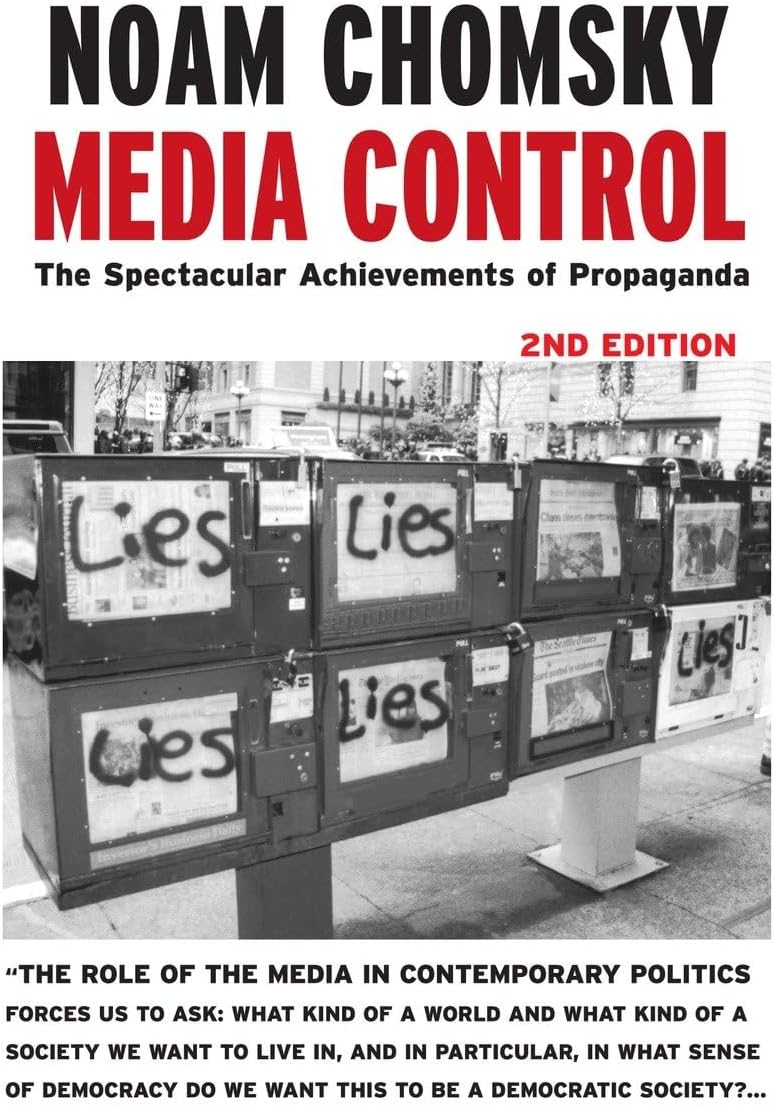
Media Control, Second Edition: The Spectacular Achievements of Propaganda
Product ID: 3831236
Buy anything from 5,000+ international stores. One checkout price. No surprise fees. Join 2M+ shoppers on Desertcart.
Desertcart purchases this item on your behalf and handles shipping, customs, and support to Lithuania.
Noam Chomsky’s backpocket classic on wartime propaganda and opinion control begins by asserting two models of democracy—one in which the public actively participates, and one in which the public is manipulated and controlled. According to Chomsky, "propaganda is to democracy as the bludgeon is to a totalitarian state," and the mass media is the primary vehicle for delivering propaganda in the United States. From an examination of how Woodrow Wilson’s Creel Commission "succeeded, within six months, in turning a pacifist population into a hysterical, war-mongering population," to Bush Sr.'s war on Iraq, Chomsky examines how the mass media and public relations industries have been used as propaganda to generate public support for going to war. Chomsky further touches on how the modern public relations industry has been influenced by Walter Lippmann’s theory of "spectator democracy," in which the public is seen as a "bewildered herd" that needs to be directed, not empowered; and how the public relations industry in the United States focuses on "controlling the public mind," and not on informing it. Media Control is an invaluable primer on the secret workings of disinformation in democratic societies. Review: Nice book - Is a very Smart book Review: We See Media Control Everyday - "The Essence of Society is engineering Consent." --Edward Bernays, adviser to Woodrow Wilson. "Media Control" is both brief and informative. The great thing about thi book is you can apply the concepts to instances in the past and present. The omniscient and omnipotent media. It dictates what most of us discuss at the dinner table, or over a cup of coffee or beer. The topics at hand are spoon-fed to us, and often our very own opinions are spoon-fed to us also. Often, we get a narrow pre-defined "choice" of 2 positions to take on these complicated topics. Often the two positions are oversimplified and more nuanced than actually opposing one another. These issues and circumstances are not that simple. But the media constructs and defines the parameters, simplifies and narrows them, and dishes them out to the public. This is the narrow field of play the mainstream media hands to us. We sheepishly accept it, often without being aware of it nor critically thinking about it. Our opinions on these chosen topics are often limited. "Media Control" is applicable for the past, present, and future. The rules basically stay the same. "Not every item of news should be published. Rather must those who control news policies endeavor to make every item of news serve a certain purpose." -Joseph Goebbels "It is the absolute right of the state to supervise the formation of public opinion." -Joseph Goebbels Recent real-life instances of "Media Control" include Freedom Fries, pre-emptive attacks, war-mongering, PNAC, and the Neo-con fad that has infiltrated the US government via appointments, and influenced the US public in recent years: A high percentage of the American public according to polling data is not interested in attacking and overthrowing governments in foreign countries. Therefore, the public has to be influenced, excited, and engineered to endorse such endeavors. Fear is the best motivator to influence public opinion. One example cited among many was the American public's perception and belief that Iraq would invade the United States. Iraqi armed forces landing on the shores of New Jersey or California? Imagine that. The Americans had to "fight them [the Sunnis) on their soil or they'd have to fight them on our soil." 7/10 American polled believe Iraq & Hussein were involved in 9-11 during the media onslaught that began with Judith Miller of the NY Times and the GWB administration. The Iraq conflict is near (perhaps) the end of US troop involvement, but it's a great illustraion of Media Control. Another example from this book is former Panamanian ally, Manuel Noriega: a small time operator that dealt drugs in cooperation with the US the government, until he fell out of favor. Noriega was made larger than life. Made into a caricature of a dangerous thug. A threat. The USA removed him and restored power to the 8% white minority elite, having U.S. military officers in positions throughout the government. Before this in the 1980s, there was the Emergency Threat to the United States: Latin American, Lessor Developed Countries, with ill-trained, and ill-equipped armies. Ironically, the Creel Commission (CPI) is noted in "Media Control," and appriately so. The Creel Commission was a propaganda campaign to get the USA involved in WWI. It's widely considered by historians to be the center of the creation of the Public Relations (PR) industry. The media is all-powerful. The thoughts most think, the tenets most believed in, and the words people say, are the words of others. Highly recommended.
| Best Sellers Rank | #376,433 in Books ( See Top 100 in Books ) #104 in Propaganda & Political Psychology #300 in Civil Rights & Liberties (Books) #484 in Communication & Media Studies |
| Customer Reviews | 4.5 out of 5 stars 1,050 Reviews |
M**S
Nice book
Is a very Smart book
K**N
We See Media Control Everyday
"The Essence of Society is engineering Consent." --Edward Bernays, adviser to Woodrow Wilson. "Media Control" is both brief and informative. The great thing about thi book is you can apply the concepts to instances in the past and present. The omniscient and omnipotent media. It dictates what most of us discuss at the dinner table, or over a cup of coffee or beer. The topics at hand are spoon-fed to us, and often our very own opinions are spoon-fed to us also. Often, we get a narrow pre-defined "choice" of 2 positions to take on these complicated topics. Often the two positions are oversimplified and more nuanced than actually opposing one another. These issues and circumstances are not that simple. But the media constructs and defines the parameters, simplifies and narrows them, and dishes them out to the public. This is the narrow field of play the mainstream media hands to us. We sheepishly accept it, often without being aware of it nor critically thinking about it. Our opinions on these chosen topics are often limited. "Media Control" is applicable for the past, present, and future. The rules basically stay the same. "Not every item of news should be published. Rather must those who control news policies endeavor to make every item of news serve a certain purpose." -Joseph Goebbels "It is the absolute right of the state to supervise the formation of public opinion." -Joseph Goebbels Recent real-life instances of "Media Control" include Freedom Fries, pre-emptive attacks, war-mongering, PNAC, and the Neo-con fad that has infiltrated the US government via appointments, and influenced the US public in recent years: A high percentage of the American public according to polling data is not interested in attacking and overthrowing governments in foreign countries. Therefore, the public has to be influenced, excited, and engineered to endorse such endeavors. Fear is the best motivator to influence public opinion. One example cited among many was the American public's perception and belief that Iraq would invade the United States. Iraqi armed forces landing on the shores of New Jersey or California? Imagine that. The Americans had to "fight them [the Sunnis) on their soil or they'd have to fight them on our soil." 7/10 American polled believe Iraq & Hussein were involved in 9-11 during the media onslaught that began with Judith Miller of the NY Times and the GWB administration. The Iraq conflict is near (perhaps) the end of US troop involvement, but it's a great illustraion of Media Control. Another example from this book is former Panamanian ally, Manuel Noriega: a small time operator that dealt drugs in cooperation with the US the government, until he fell out of favor. Noriega was made larger than life. Made into a caricature of a dangerous thug. A threat. The USA removed him and restored power to the 8% white minority elite, having U.S. military officers in positions throughout the government. Before this in the 1980s, there was the Emergency Threat to the United States: Latin American, Lessor Developed Countries, with ill-trained, and ill-equipped armies. Ironically, the Creel Commission (CPI) is noted in "Media Control," and appriately so. The Creel Commission was a propaganda campaign to get the USA involved in WWI. It's widely considered by historians to be the center of the creation of the Public Relations (PR) industry. The media is all-powerful. The thoughts most think, the tenets most believed in, and the words people say, are the words of others. Highly recommended.
A**T
Very high-level
If it were any other author, I would say, "show me your sources." But it's Chomsky, and he's already written enough books showing his sources. This one isn't meant to be a footnoted volume of case-and-point. It's just a nice high-level essay highlighting the absurdity of the rhetoric of our times. I do have one complaint though. I wish this focused a little bit more on the media than the government. Chomsky blends the two together and speaks of one as if it's the other. Hmmmm...on second thought, maybe he did that on purpose. Anyway, a light read for Chomsky fans and a nice intro for those unfamiliar with his work.
R**Z
The Media - Selected Lies For the Public
Speaking for myself, I get sick when I hear "CNN, The Most Trusted News," and watch Fox and every other mind-melted American media. I have to admit, I also get nauseated (literally) in just the sight of G.W. Bush or any of his administration attempting to tell the "truth." And what's even more disturbing are the supporter's; Blind and angry fighters with bias moral slants and empty slogans. On the other hand, PBS and Comedy Central are refreshing alternative exceptions to all of these deceptions. Chomsky relates two types of democracy - one where the majority of people are politically active participants, heard, listened and considered. The other, which is what we have, is a vanguard or specialized class of representatives that do the voicing for everyone - the only participation of the public during their elections. And this is what has been both in Lenin's and U.S. liberal's idea; that of a specialized vanguard political and business class endorsed to protect the bewildered public who simply can't think for themselves. In this, modern U.S. propaganda had its beginning with Woodrow Wilson's Creel Commission and later Red Scare. While former tactics used have been the Creel Commission and the Red Scare, attacks are still used unions and all political organizations with the separating and isolating of people; distracting them with consumerism, TV sitcoms and the Superbowl - to name only a few. Also the use of catchy and empty phrases as "Do you support the," and "Are you for or against." This is used along with many superficial forms of entertainment, gossip columns, sporting events and many other diversions. The bottom line is a One party system, a One business system, with two divisions of the same party - the Democrats and Republicans. While these distractions and attacks on unions and political organizations have been very successful, they have not broken up the Churches, which act as the few places left for organization and political speeches against propaganda. An example is the recognition that war is wrong, while the government calls those against the Vietnam War part of a Vietnam syndrome, weak and sickly persons. You name it - the Middle East, Central America, National terrorism - it's all been lied upon by our media and governmental official history, including the number killed in Vietnam, declaring less than a million Vietnamese, while other sources reveal millions. What do we think when other countries and groups lie about the amount of people murdered in the Holocaust? It was only until the 1960's that the culture awakened unlike before. Even in highly prejudice and opinionated parts of the country, open talks can now be given. Where formerly there was both the lack of understanding and opposition, now there is still opposition but with much more understanding and at least some type of semi-organizational national movements despite all the media propaganda. In our recent times with unemployment raised, lower wages, loss of health care affordability, dwindling social security, and much more poverty than before, the sitcoms, consumerism and the Superbowl are not enough. The tactics needed are to continually create new enemies to fight, new terror to control and general fear within the public; as in Saddam Hussein, Bin Laden, Castro, Quadhafi, drug traffickers, Arabs - all with our magnificent military force that wipes out these supposed tyrannies - in reality they are weak third world armies - all acting as distractions and diversions from the real truth; U.S. imperialism and abuse of labor and natural resources by the few powerful and wealthy. Cuba is likely to be next. In an effort to gain control over labor and natural resources and prevent economic independence, the strategy is to first provoke them. And then when they act under defense, they are set-up under the lie of offence as reported by the media, demanding that we defend and brilliantly crush them under patriotic morals and values. "God Bless America." Now we can all relax with a sigh of relief now that this terrible dictatorial tyranny has been eliminated and decent human rights and values have been restored. 9. While the media widely publicized the jail and torture of the former Cuban prisoner, Armando Valladares, and the U.S. both commending him for his courage and then appointing him as a representative of the UN human rights commission, a much more detailed, mountainous evidence of signed affidavits of human rights commission members in El Salvador imprisoned and tortured by the U.S., and acquired by Hebert Anaya were entirely ignored by the media. Only one small blurb mentioned. And when finally released from prison, he was quietly assassinated by U.S. backed security forces. People who were polled responded against countries that occupy others illegally and perform human rights abuses. And yet all over the globe, both the U.S. and U.S. backed forces do just that, an example being the U.S. backed invasion, torture and killings of Indonesia to those in East Timor, killing over 200,000, while the media remains silent. And while Israel occupies Lebanon illegally against UN resolution 425, with U.S. backing, killing over 20,000 in Beirut, hospitals and vital centers, there is no media coverage. Over the years, the media refused to report to the public the critical voices of the Iraqi democrats around the world since they condemned the U.S. friendly relations with Saddam Hussein. Only after Saddam became the enemy were their voices given any coverage. But no sooner did they voice their antiwar sentiments and opinion against imperialistic maneuvers; they were again completely ignored by the media. You can only read about them in some of the German and British press. What does this say of our democracy? Chomsky gives the reasons U.S. gave for the Gulf War; Aggressors can not be rewarded and must be reversed by violence. And yet the U.S. does this all the time and no one questions their aggressions, as in their 20 years of quiet diplomacy (no attack) of South Africa's killings, 1.5 million in just the Bush-Reagan years. Again no media coverage, a hallmark sign of a totalitarian and bias culture. While two-thirds of Americans polled favored peace negotiations with Iraq, the media continued to drill the government's view of no diplomacy. Meanwhile Iraq had offered total withdrawal, and again no coverage. Any who thought of negotiations were made to feel like oddballs since the media shows that no one thinks this way. And no Democrat dared speak up either. While the U.S. blocks sanctions against Israel for her defying the UN in illegally occupying Lebanon since 1978, it hypocritically employs sanctions against Cuba and Iraq. And these have worked, weakening Iraq tremendously. Negotiations are offered by Iraq, but Bush refuses for the same economic exploitative reasons in a small country torn by a war with Iran. And now suddenly it is a dangerous power that threatens the entire world with lies about stockpiles of chemical weapons and WMD. The same exact tactics were used only a year earlier on Nicaragua's Manual Noriega, deceptively elevated to a large and dangerous drug trafficking threat to the world. But he had to be smashed, killing hundreds, maybe thousands of people, and restoring a vicious police state. History repeats itself. It's all about whether we want a pseudo democracy of representatives and servitude or a free democracy of active citizen participation. These are our choices.
F**I
An Appetizer: People with Real Power vs. Masses
Propaganda is a form of communication that aims to influence attitudes toward a cause or position. It is primarily aimed to influence an audience. Fundamentally, it should be a neutral term. However, it grew up with a negative connotation by association with the world wars. In 1924, Adolf Hitler wrote that "propaganda is a truly terrible weapon in the hands of an expert". While the term propaganda might evoke oceaninc crowds of people rising arms and shouting "Heil Hitler" it is important to note that it was not invented by the Nazis. The original latin word refers to the biological reproduction of flora and fauna (to propagate, things that must be disseminated), whereas the Papacy coined the phrase propaganda fide. The Sacred Congregation for the Propagation of Faith is a Congregation of the Roman Curia for the Evangelization of Peoples (Congregation pro Gentium Evangelizatione). In 1622, Pope Gregory XV founded the Sacra Congregatio de Propaganda Fide (sacra congregatio christiano nomini propaganda) but it was Pope Urban VIII who made it an institution. Noam Chomsky's Media Control is a little and easy to read book. Loved it. If you get a chance and you would like to know what is the role of the media in contemporary politics (and open your mind to new ways of thinking if you are not familiar with Propaganda) this is a book for you. Clearly, it is U.S. centric (as pretty much all the books available to market). It will take one hour of your time (more or less depending on your reading skills) to be read. Noam Chomsky goes directly to the point and his thinking will not leave the reader disappointed. You might wish to try it as an appetizer. Then, if you want more. There's much more Content worth reading/watching/listening to from Noam's brilliant mind.
A**N
It reads like a children's book
It reads like a children's book. It seems incredibly dumbed down compared to Chomsky's ordinary style of reading. The information and arguments are solid, but the delivery almost comes off as almost condescending because it's so simplified. If you're looking for a book that will educate a person with a third-grade reading level about the workings of the mainstream media, this is it!
J**M
Succinct, Hits the Nail on the Head
I've read and listened to most of Noam Chomsky's work. I found this 1991 (with a 2003 speech added to the 2nd edition) book to be an eye opener simply because it is such a succinct overview of how our (spectator) democracy works. The original part of the book is 65 small pages. I read it twice. It is particularly relevant in an election year. The 2nd edition speech is playful narrative of how a Martian journalist would view human civilization and report back to the home planet. The big picture for the folks back on the home planet. Highly recommended!
M**.
If you know Noam, you will like this quick read
Though this is a quick fast read, it is great material. And if you are curious about how media and propaganda are intertwined, this may just convince you about what we always suspected. As a great friend of mine once quipped: "why do you think they call it programming?"
D**L
umfassendes provokantes und gut gelungenes Werk
Media Control: The Spectacular Achievements of Propaganda von Noam Chomsky ist eine kritische Analyse der Rolle der Massenmedien in modernen Gesellschaften, insbesondere in den USA. Das Buch basiert auf einer Vortragsreihe Chomskys und thematisiert, wie Medien als Instrumente zur Manipulation der öffentlichen Meinung genutzt werden, um politische und wirtschaftliche Eliten zu unterstützen. Chomsky erklärt in seinem Werk, wie Propaganda und gezielte Medienberichterstattung genutzt werden, um die Bevölkerung von wichtigen politischen Fragen abzulenken oder zu beeinflussen. Er zeigt auf, dass die Medien häufig nicht dazu da sind, objektiv zu informieren, sondern eher dazu, bestehende Machtstrukturen zu stabilisieren und die öffentliche Zustimmung für staatliche oder unternehmerische Interessen zu sichern. Der Begriff “Manufacturing Consent”, den Chomsky in früheren Arbeiten verwendet, wird auch hier deutlich – Medien formen die Meinung der Massen, um ein Konsensbild zu erzeugen, das oft den Interessen einer kleinen, privilegierten Elite dient. Eines der zentralen Themen des Buches ist die Vorstellung, dass demokratische Gesellschaften, obwohl sie das Ideal der Meinungsfreiheit propagieren, stark von einer elitären Kontrolle über die Informationen geprägt sind, die den Menschen zur Verfügung gestellt werden. Chomsky zieht dabei Parallelen zwischen den Techniken moderner Propaganda und denen, die in totalitären Regimen angewendet werden – allerdings auf subtilere Weise. Ein berühmtes Beispiel, das er diskutiert, ist die Manipulation der Berichterstattung über Kriege und internationale Konflikte, wobei die US-Regierung systematisch Informationen filtert, um militärische Aktionen zu rechtfertigen und die Öffentlichkeit davon zu überzeugen, dass sie notwendig und gerechtfertigt seien. Media Control ist ein kurzes, aber kraftvolles Buch, das dem Leser ein tieferes Verständnis darüber vermittelt, wie Medien zur Beeinflussung der öffentlichen Meinung genutzt werden können. Chomskys Sprache ist klar und zugänglich, auch für diejenigen, die keine tiefen Vorkenntnisse in der Medienkritik haben. Obwohl das Buch erstmals 1991 veröffentlicht wurde, sind die darin behandelten Themen und Analysen immer noch hochaktuell, besonders im digitalen Zeitalter, in dem soziale Medien und alternative Informationsquellen eine noch stärkere Rolle spielen. Fazit: Media Control ist eine aufschlussreiche und kritische Auseinandersetzung mit der Macht der Medien in modernen Demokratien. Noam Chomsky zeigt eindrucksvoll, wie die Medien verwendet werden, um Meinungen zu steuern und gesellschaftliche Kontrolle auszuüben. Ein wichtiges Buch für alle, die sich mit Medien, Politik und Propaganda auseinandersetzen möchten.
P**O
open your mind
ne avevo sempre sentito parlare e citare in conferenze... essenziale per capire, comprendere e interpretare i fatti e le notizie che i media diffindono con attribuendosi troppe volte l'arroganza dell'imparzialità. Consigliato davvero!!
L**T
The bewildered herd must be tamed
Noam Chomsky explains perfectly how propaganda spectacularly achieved to turn `real' democracy, where the public participates meaningfully in state affairs, into `spectator' democracy, where the public is occasionally allowed to elect one or another member of a specialized class. Spectator democracy is based on the assumption that the stupid masses (`the bewildered herd') are too dump and incompetent to really understand their own interests. Only a small elite, the decision makers, can understand the common interest. The bewildered herd must be tamed by, among other means, propaganda. But who benefits? How get the decision makers into their position? The answer is very simple: by serving people with real power, by defending the interests of private power and the state-corporate nexus. Noam Chomsky dissects brilliantly the propaganda machine with its use of disinformation, falsification of history, and marginalization of dissident opinion. He gives perfect examples of propaganda, like the Creel commission in WWI, which turned a pacifist majority of the people into a warmongering crowd, or the battle against the `Vietnam syndrome' (`the sickly inhibitions against the use of military force'), or the use of fear of enemies in order to hide real domestic problems (health, education, homelessness, joblessness, crime, soaring criminal populations, jails, deterioration in the inner cities). Ultimately, the bewildered herd will never be tamed completely. It will have to choose between a real free society and a self-imposed totalitarianism where it will be marginalized. A brilliant essay by a superb free mind. We need Noam Chomsky's loud and clear voice.
S**A
Short history of Corporate media
No explanation is needed about the writer. This is a short book which starts from the genesis of corporate media. It explains how the propaganda is made by the media to control the common people. This is truly a great book.
R**N
Short and essential
He really does rely heavily on data collection, in both his political and linguistic work. So this short book is all you need. Otherwise theres the necessary illusions lectures. Then manufacturing consent, the tome. But theres a doc for that. Ive just lately gotten really concerned abt media as propaganda, since russiagate imploded. And that michael jackson doc has been refuted. Can you believe it: michael jackson wasnt a pedophile! Its all been just grifters and tabloids (fake news). I was a fan. I abandoned him. And, after some digging, im completely confident it was all smear. Im so betrayed. (Meh, no, im not absolutely certain. Ill never be. But i choose to believe it was a frame up, and that the medias certainly completely capable of doing that...) Ya, so i wish chomsky wd talk abt that kinda consent manufacturing. But u cant blame him for goin after the big fish, atrocities in s america covered up by the new york times and washington post. Once u rd chomsky, u can never go back to how u thought the world worked
Trustpilot
2 months ago
3 weeks ago