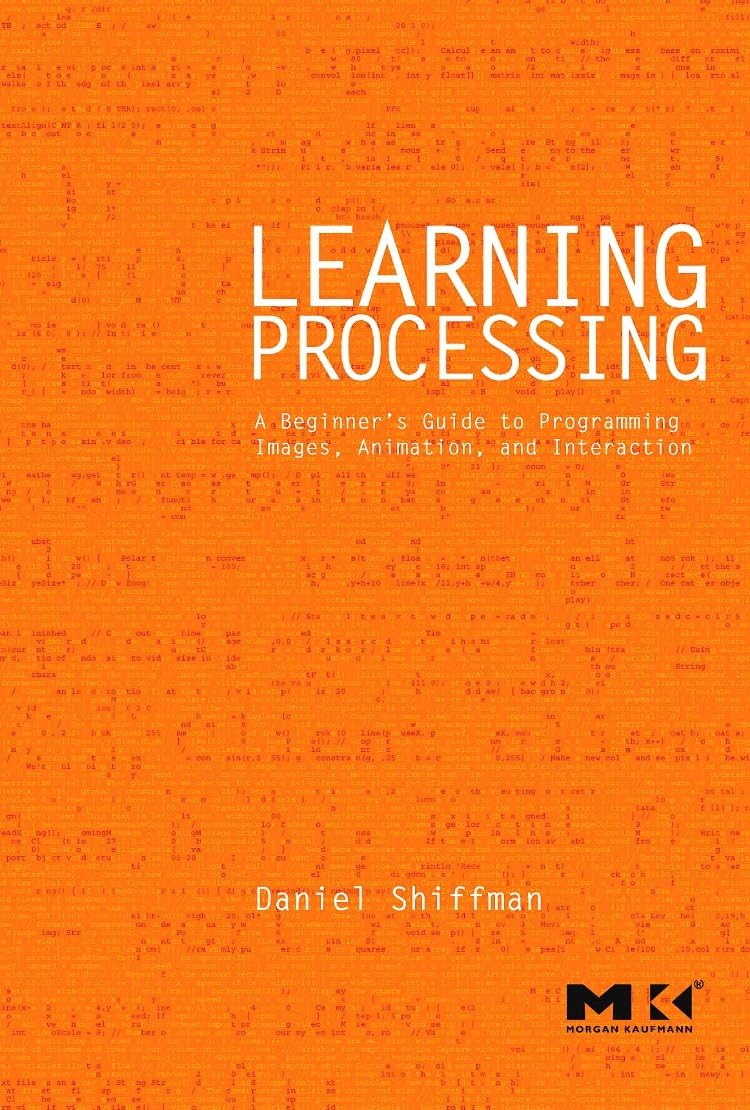
Learning Processing: A Beginner's Guide to Programming Images, Animation, and Interaction (Morgan Kaufmann Series in Computer Graphics)
Product ID: 2709452
Buy anything from 5,000+ international stores. One checkout price. No surprise fees. Join 2M+ shoppers on Desertcart.
Desertcart purchases this item on your behalf and handles shipping, customs, and support to Lithuania.
The free, open-source Processing programming language environment was created at MIT for people who want to develop images, animation, and sound. Based on the ubiquitous Java, it provides an alternative to daunting languages and expensive proprietary software. This book gives graphic designers, artists and illustrators of all stripes a jump start to working with processing by providing detailed information on the basic principles of programming with the language, followed by careful, step-by-step explanations of select advanced techniques. The author teaches computer graphics at NYU's Tisch School of the Arts, and his book has been developed with a supportive learning experience at its core. From algorithms and data mining to rendering and debugging, it teaches object-oriented programming from the ground up within the fascinating context of interactive visual media. Previously announced as "Pixels, Patterns, and Processing" *A guided journey from the very basics of computer programming through to creating custom interactive 3D graphics *Step-by-step examples, approachable language, exercises, and LOTS of sample code support the reader's learning curve *Includes lessons on how to program live video, animated images and interactive sound Review: The right choice for your first Processing book - In short, if you want to get started in Processing, you won't regret getting this book. I am teaching a course about mathematics and computers and programming, and learned about Processing shortly before the course began. I am always interested in programming languages that are easy to learn, and provide quick visually appealing results to the learner. Processing is definitely such a language. So, in a scramble to add Processing to my syllabus because it was such a good fit, I needed some books to quickly get me up to speed. I purchased this, and I purchased Ira Greenberg's "Processing: Creative Coding and Computational Art". I really like both books a lot, but this book, "Learning Processing", is wonderfully put together and would serve well as either a textbook for a course in programming, or as an introduction to a casual user, whether or not that user has any prior programming experience. The content organization of this book is excellent, and includes examples that are both instructional and inspiring. See, for example, the fractal examples in the section on recursive functions. Beautiful examples made understandable. (By contrast, Greenberg's book is loaded with wonderful examples as well, but the content organization and the lengthy but interesting prose may put off someone who is new to programming and is trying to get up and running quickly.) I can't recommend this book enough if you are thinking of learning Processing. It's a fun language, worthy of any attention it is getting as an introductory programming language (our university uses Processing to teach a course in "Aesthetics & Computation"). And "Learning Processing" is a great book for learning the language. Review: Excellent as a textbook for Intro to Programming! - I am a college professor at a small California Community College. I stumbled onto processing about three years ago, just when I was designing a new 'first course' in programming. I decided at the time to go with an existing textbook which used Java as a first language. I was not happy with the results. When I got a look at the Shiffman text, I got excited about processing again. I used other material to supplement in areas such as number systems, Von Newmann architecture, and the rest. I introduced Processing about 1/3 of the way through the class and students picked it up very quickly using the text. We went through about 11 chapters in about 8 weeks, and students developed quite a few cool interactive and graphical apps with loops, conditionals, arrays, File I/O and even a few objects! And the best part is that they enjoyed it! I gave students a 'Course Feedback Survey' at the end where they rated aspects on a scale of 1-10 (1 = strongly disagree, 10 = totally agree). They gave the question "The textbook did a great job of explaining the material" an average of 9 out of 10. I am adapting the course to teach it fully-online next Fall, and I'm excited about using the Shiffman text again. I was able to contact the author who provided additional support for me to work up some decent PPT slides to use for the class. The book goes well beyond what I am using it for, and introduces quite a few topics that I have not reviewed or used (yet). It has a good index, is sprinkled with graphic diagrams, and has excellent supplements online (example code and such). I am also expecting great things from the students that used this book in their next programming class (standard CS1 with Java). I might even use some of the more advanced examples for my CS1 class too! Congrats Daniel on a job well done!
| Best Sellers Rank | #2,435,583 in Books ( See Top 100 in Books ) #568 in Computer Graphics #958 in Game Programming #1,122 in Graphics & Multimedia Programming |
| Customer Reviews | 4.6 out of 5 stars 113 Reviews |
N**E
The right choice for your first Processing book
In short, if you want to get started in Processing, you won't regret getting this book. I am teaching a course about mathematics and computers and programming, and learned about Processing shortly before the course began. I am always interested in programming languages that are easy to learn, and provide quick visually appealing results to the learner. Processing is definitely such a language. So, in a scramble to add Processing to my syllabus because it was such a good fit, I needed some books to quickly get me up to speed. I purchased this, and I purchased Ira Greenberg's "Processing: Creative Coding and Computational Art". I really like both books a lot, but this book, "Learning Processing", is wonderfully put together and would serve well as either a textbook for a course in programming, or as an introduction to a casual user, whether or not that user has any prior programming experience. The content organization of this book is excellent, and includes examples that are both instructional and inspiring. See, for example, the fractal examples in the section on recursive functions. Beautiful examples made understandable. (By contrast, Greenberg's book is loaded with wonderful examples as well, but the content organization and the lengthy but interesting prose may put off someone who is new to programming and is trying to get up and running quickly.) I can't recommend this book enough if you are thinking of learning Processing. It's a fun language, worthy of any attention it is getting as an introductory programming language (our university uses Processing to teach a course in "Aesthetics & Computation"). And "Learning Processing" is a great book for learning the language.
D**H
Excellent as a textbook for Intro to Programming!
I am a college professor at a small California Community College. I stumbled onto processing about three years ago, just when I was designing a new 'first course' in programming. I decided at the time to go with an existing textbook which used Java as a first language. I was not happy with the results. When I got a look at the Shiffman text, I got excited about processing again. I used other material to supplement in areas such as number systems, Von Newmann architecture, and the rest. I introduced Processing about 1/3 of the way through the class and students picked it up very quickly using the text. We went through about 11 chapters in about 8 weeks, and students developed quite a few cool interactive and graphical apps with loops, conditionals, arrays, File I/O and even a few objects! And the best part is that they enjoyed it! I gave students a 'Course Feedback Survey' at the end where they rated aspects on a scale of 1-10 (1 = strongly disagree, 10 = totally agree). They gave the question "The textbook did a great job of explaining the material" an average of 9 out of 10. I am adapting the course to teach it fully-online next Fall, and I'm excited about using the Shiffman text again. I was able to contact the author who provided additional support for me to work up some decent PPT slides to use for the class. The book goes well beyond what I am using it for, and introduces quite a few topics that I have not reviewed or used (yet). It has a good index, is sprinkled with graphic diagrams, and has excellent supplements online (example code and such). I am also expecting great things from the students that used this book in their next programming class (standard CS1 with Java). I might even use some of the more advanced examples for my CS1 class too! Congrats Daniel on a job well done!
C**S
Excellent treatise on the processing language.
Gets a little bit carried away with some of the homey illustrations, but is a good book. One deficiency that needs correcting is that the index is dismally brief. Particularly for beginning students of Processing this is a serious deficiency. The main topics are stated in the table of contents, but some of the secondary importance concepts are not identified.
A**R
A great book for learning programming
I recommend Learning Processing by Daniel Shiffman to anyone who wants to learn a programming language. The book is well written. All the answers to Examples and Exercises are on the books website. The software to produce stand alone programs that run on computers, other programmable devices and the web is free. You learn to write code that produces graphic output right from the first lesson. Everything is available so that you could learn the language on your own from this book. It is a step-by-step course that teaches all the basics and more. All the things the Author says in the Introduction I have found to be true. Orrick Hampton Technology Coordinator Rio Hondo Prep
J**Y
... learn the most basic coding in game programming I recommend this. In my game programming class we started ...
If you want to learn the most basic coding in game programming I recommend this. In my game programming class we started off with this and gradually went on to learning how to use Unity. This book is pretty instructional with a step by step and pictures to help you learn what the coding does. It then has mini reviews with questions that reinforce the coding that was mentioned in the chapter, so something will definitely stick. With picking up this basic coding language, it will definitely help with learning and reading other coding languages.
M**E
Processing - Java for the rest of us.
I first learned about Processing through the FunProgramming.org website, which features more than 100 short programming examples of Processing. At some point I decided I needed some sort of reference besides what I find online and started looking for a book that would give me a good overview of the language. I chose 'Learning Processing' as the index appeared to cover a number of topics that were of interest to me. Daniel Shiffman Beginners Guide delivers. I've not even attempted any animation at this point, but in my estimation, I've gotten my money's worth. Besides an emphasis on the basics of computer animation, Shiffman presents two very clearly written chapters on Object Oriented Programming and how it relates to building complex graphic structures. Did I mention that Processing runs on a Mac? My only real problem with the book is that it seems directed towards high school students or college freshman, at the most. The examples are a bit simplistic and the book is designed around a workbook format which only adds to that high school look and feel, at least from what I can remember of high school. Other than that, I'm more than pleased with my choice. If you're interested in learning about Processing, this is a book I'd recommend as it covers a lot ground, plus all of the examples are online are free to download.
A**R
The Friendliest Book
I just received this book yesterday, and I have to say that this book is probably the friendliest "instructional" book. I say instructional, instead of programming because as a designer, I can comprehend the concepts that Shiffman talks about. It's even friendlier than some Photoshop and Flash books that I've read through. I have both Shiffman's and Casey Reas' book (last year), and I'm starting Shiffman's book. Casey's book is for intermediates. I would even recommend this book to high school students who are interested in programming, however, most high school students are professional programmers already (look at the kids that work on Facebook).
C**N
A standout!
This is a terrific book to learn something about programming. The author knows not only his subject but also how to present that subject to others in an engaging way. Think that's easy? Pick up any programming box from a shelf, and the book picked up will quickly answer that question for you. I am of the opinion that anyone can complicate an involved subject; but rare is the person who can simplify so other may share in that knowlege. I know of only one other book that I find as clear and that is a book on computer hacking-of all things.(Jon Erickson) Thanks to the author for making programming fun and engageing. I know I have kept this review fairly general but I did not want to introduce any control structures that might make some peoples' train of thought loop. Hooray to Mr Shiffman!
V**.
processing
ottimo libro pr imparare ma anche per perfezionare lo stile di programmazione
J**.
Great book that has lessons that build upon one another
Great book that has lessons that build upon one another. The book is also strongly supported by a website with lots of content and resources. Processing makes learning java fun and visual. I use this to help introduce students to computer science.
A**N
Perfect for teaching students how to program
This is a first class introduction to programming for students wanting to get to grips with programming concepts quickly and effectively. After spending many years teaching Pascal and C (and on the odd occasion with more advanced students, TCL/TK) I now use it every year with my new A-Level group. Processing is an excellent Java wrapper and not only do the students get lots of positive feedback from the language as they rapidly build small graphics programs, but as they progress, the full functionality of Java becomes available to them. Daniel Shiffman writes very well - his style is chatty but always accurate. The pace is well judged, gentle at the beginning, quicker as the student becomes grows in confidence. Most importantly, it's a book that the students take home and read with enjoyment, not something that can be said for all programming books.
電**ん
Processingを高校生のサマーセミナーに教えるときに勉強として使いました
Processingを高校生のサマーセミナーでおしえなければいけなくなりました。高校生には日本語の教科書を指定しましたが、なにしろ書かれている内容が薄いので、せめて、講師側はきちんと勉強しておこうと購入しました。通勤の往復の電車のなかで数日で読みきれましたが、よいことが沢山かかれています。大学生以上ならこれを読めるでしょうから(英語は平易)、内容が濃いものを読みたければ、初心者から始められて中級弱程度までは(Processingの)これで行けるでしょう。 非常に良い本です。目からうろこ。翻訳でなく、英語で読んでも読みやすいし、内容が良いので、是非、Processingを学ぶ人は日本語の本の次にこれを読んでみてください。
A**S
Excellent Starter
This book is an excellent one to get you started with Processing. Although I have quite an experience with programming, I strongly believe it is an excellent book to get a newbie started. Lots of very helpful sample code and excellent support at book's website. Furthermore, writer was available to discuss and answer delicate/advanced questions and references.
Trustpilot
2 days ago
5 days ago