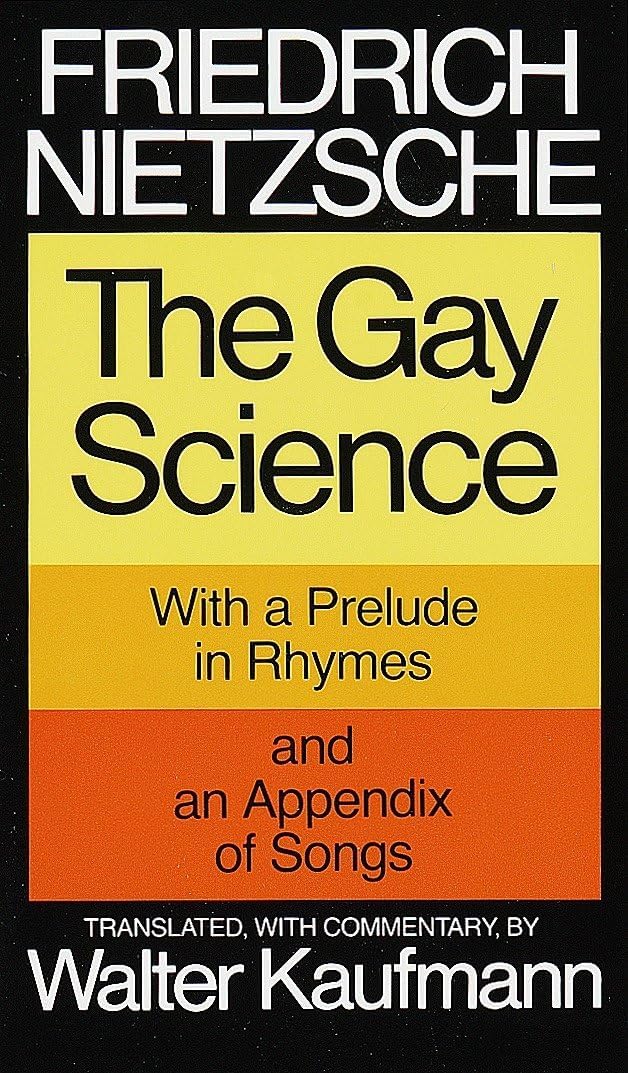
The Gay Science: With a Prelude in Rhymes and an Appendix of Songs (COLLECTIBLE)
Product ID: 221333
Buy anything from 5,000+ international stores. One checkout price. No surprise fees. Join 2M+ shoppers on Desertcart.
Desertcart purchases this item on your behalf and handles shipping, customs, and support to Lithuania.
The book Nietzsche called "the most personal of all my books." It was here that he first proclaimed the death of God—to which a large part of the book is devoted—and his doctrine of the eternal recurrence. Walter Kaufmann's commentary, with its many quotations from previously untranslated letters, brings to life Nietzsche as a human being and illuminates his philosophy. The book contains some of Nietzsche's most sustained discussions of art and morality, knowledge and truth, the intellectual conscience and the origin of logic. Most of the book was written just before Thus Spoke Zarathustra , the last part five years later, after Beyond Good and Evil . We encounter Zarathustra in these pages as well as many of Nietzsche's most interesting philosophical ideas and the largest collection of his own poetry that he himself ever published. Walter Kaufmann's English versions of Nietzsche represent one of the major translation enterprises of our time. He is the first philosopher to have translated Nietzsche's major works, and never before has a single translator given us so much of Nietzsche. Review: Alive, Electric—Crackling With Energy! - The structure of the book is this: • 63 poems (this is the “Prelude in Rhymes”) • 5 books with 383 sections in total (this is “The Gay Science” proper) • 14 songs (this is the “Appendix of Songs”) In this book, Nietzsche makes many perceptive observations about history, religion, morality, women, art, music, culture, Christianity, Jews, Germans, Europeans, suffering, joy, and much more. This is also where he first declares that “God is dead,” and where Zarathustra is first mentioned in his writings. In fact, he wrote Thus Spoke Zarathustra right after finishing book four. Book five was written a few years later, after he finished Beyond Good and Evil. Something vital to keep in mind: As Kaufmann notes, this book (these “books,” really) is not meant to be read willy-nilly; it is to be read in order and bearing the context in mind; this point cannot be stressed enough. Now to speak of the general spirit of the book: Nietzsche wrote elsewhere (Twilight of the Idols, Raids of an Untimely Man, 51), “The aphorism, the apothegm, in which I am the first among the Germans to be a master, are the forms of ‘eternity’; it is my ambition to say in ten sentences what everyone else says in a book—what everyone else does NOT say in a book” (“NOT” is italicized in the original, not capitalized; but since I can’t italicize here, I capitalized the letters for emphasis). If you want philosophical writing that’s dense, layered, and packed with meaning, all in a single breath, look no further! It’s not just about economy of language but a kind of compression that forces you to slow down and unpack every word. Agree or disagree with his ideas, you’re sure to be taken for a ride! I personally don’t “agree” or “disagree” but rather “relate” or “don’t relate”—and it’s usually the former! I’ve found this to be an excellent entry into Nietzsche’s writing. I’ll probably go with either Thus Spoke Zarathustra or Beyond Good and Evil next, depending on my mood. All in all, this isn’t just a book; it’s an experience, a diary of sorts. He himself calls it “the most personal of all my books.” I highly recommend it for the right person at the right time. Review: Excellent resource! - Excellent resource!

| Best Sellers Rank | #20,344 in Books ( See Top 100 in Books ) #9 in Free Will & Determinism Philosophy #16 in Individual Philosophers (Books) #17 in Modern Western Philosophy |
| Customer Reviews | 4.6 out of 5 stars 592 Reviews |
R**N
Alive, Electric—Crackling With Energy!
The structure of the book is this: • 63 poems (this is the “Prelude in Rhymes”) • 5 books with 383 sections in total (this is “The Gay Science” proper) • 14 songs (this is the “Appendix of Songs”) In this book, Nietzsche makes many perceptive observations about history, religion, morality, women, art, music, culture, Christianity, Jews, Germans, Europeans, suffering, joy, and much more. This is also where he first declares that “God is dead,” and where Zarathustra is first mentioned in his writings. In fact, he wrote Thus Spoke Zarathustra right after finishing book four. Book five was written a few years later, after he finished Beyond Good and Evil. Something vital to keep in mind: As Kaufmann notes, this book (these “books,” really) is not meant to be read willy-nilly; it is to be read in order and bearing the context in mind; this point cannot be stressed enough. Now to speak of the general spirit of the book: Nietzsche wrote elsewhere (Twilight of the Idols, Raids of an Untimely Man, 51), “The aphorism, the apothegm, in which I am the first among the Germans to be a master, are the forms of ‘eternity’; it is my ambition to say in ten sentences what everyone else says in a book—what everyone else does NOT say in a book” (“NOT” is italicized in the original, not capitalized; but since I can’t italicize here, I capitalized the letters for emphasis). If you want philosophical writing that’s dense, layered, and packed with meaning, all in a single breath, look no further! It’s not just about economy of language but a kind of compression that forces you to slow down and unpack every word. Agree or disagree with his ideas, you’re sure to be taken for a ride! I personally don’t “agree” or “disagree” but rather “relate” or “don’t relate”—and it’s usually the former! I’ve found this to be an excellent entry into Nietzsche’s writing. I’ll probably go with either Thus Spoke Zarathustra or Beyond Good and Evil next, depending on my mood. All in all, this isn’t just a book; it’s an experience, a diary of sorts. He himself calls it “the most personal of all my books.” I highly recommend it for the right person at the right time.
V**Y
Excellent resource!
Excellent resource!
B**D
Kindle Edition of Nietzsche's Most Engaging Work
This review addresses the Kindle edition of Kaufmann's translation of what I have come to believe is Nietzsche's most engaging work, the one which gives some of his most interesting psychological insights, done in his period of greatest productivity, just before and during the writing of Also Sprach Zarathustra. (Beyond Good and Evil and A Geneology of Morals are also very important.) Unlike "Beyond Good and Evil", there are some excellently even-handed comments about women in this book. This may be the first book I am reading 'from cover to cover' on a Kindle, and the experience is rewarding. There are several things which are annoying about Kindle, but one of the very best aspects is the way it handles footnotes. Click on a footnote number, and it immediately takes you not only to the page where that note appears, but it puts the note at the top of the page. This is something no hard copy can do. The other side of the coin is that it suffers from Kindle's difficulty in handling bilingual texts. It takes a whole lot of jiggery pokery to have the German and English versions of the poems to come out side by side. I'm not even sure it's possible. Fortunately, the poems are numbered, for those who don't know German. Note that some of Kaufmann's Nietzsche books are protected from copying, which is hugely annoying when you are writing papers, and you want an accurate quote. This one has no such prohibition. I am fond of Kaufmann's translations, and the Cambridge University Press edition is not available on Kindle, so this is the one to get. Avoid the cheap or free versions. What is listed under the Cambridge Kindle is NOT the translation published by Cambridge. One general comment about Kindle on the PC. It would be really nice if one could open multiple Kindle windows. That way, you could have the English translation and the original German of Nietzsche's works open, side by side. Of course, you can always open the German in you Kindle device and prop it up alongsize your monitor.
O**S
On the product
The book was shipped appropriately - it was a day or two after it was promised, but that is the only complaint on the shipping. The binding and its covers are of a relatively good quality; however I found an older version (still the same walter kaufmann translation) in Half Price Books which had a binding and covers of superior quality - and after reading the two, the older version looks almost impeccable with little to no creases (this was the first day). However the page quality, the material and overall the printing of the book (a few misprints, like three or four) are very neat and well done. 3.5/5 stars.
R**L
An excellent starting point in modern thought.
This book is a masterpiece in my estimate, and I wanted it with its original English title. I got it, and it came on time and in perfect shape !!!
A**K
Heraclitus comes to the fore-- Im Fluss:Panta rei
The best first and/or last step into Friedrich Nietzsche's thought. It reads quickly and gives a fair cross-section of his writings chronologically: just before TSZ, right after his "free spirit" epoch, and Bk. V from around the time of Beyond Good & Evil. Only a shame that a Hollingdale translation is not available in English. And now some buffoonery from yours trulery. Down Going Limerick Zarathustra is now down going And so he speaks in rhyme: The madman said, "God is dead. Where is he? Is it we who killed a lie?" Now I Exhort You to Love What is Most Distant, to Dionysus Against the Crucified. Burn Your Ships and move to Inland Deserts Onward--To the Great Noontide, For The Twilight of the Idols Approaches, And The Overman's Time is Well Nigh. At Last Behold the Higher Man-- Whom With Hammer Doth Philosophize: "You yourself are this Will to Power, and nothing else besides!" Now Completely Drunk With Laugher, And Unafraid to Die The Higher Man Declares: Amor Fati! Finally Dionysus Will Fly! Thus Spoke Zarathustra in His Down Going Of the Innocence of Becoming from on High. "Together, Apollo and Dionysus unite Against the Crucified." Thus Spoke Zarathustra The Sorcerer unpursed his lips laying his flute beside him, and sighed.
J**G
The majesty of the powerful
In Nietzsche's GAY SCIENCE, he speaks of the nature of power and how it can be mishandled. His example is that of Luther and the Church. Luther, according to Nietzsche, wanted to save the Church from the impending secularism of its evolution towards the Enlightenment. That religious power should find the maturity of its ultimate expression in secular enlightenment was beyond Luther's power to see. He rushed to "save" the Church, by "reforming" it, and thus undermined its authority in the broader scope of life. After Luther's intervention, the influence of the Church became narrower; its authority diminished. Nietzche effectively chastises Protestant reformer Martin Luther for being of the lower classes and hence not understanding how power actually worked. By virtue of his lack of knowledge and experience of power, he achieved the opposite to that which he had set out to achieve. One way of looking at Luther and his intervention is that Luther was a "Beta" male. He didn't understand that power, in order to maintain itself as genuine authority, has to exert itself with in subtle ways. Luther's efforts therefore made the Church's influence appear cruder and more harshly defined. This was the means by which he stripped the Church of power -- by defining power too narrowly, and by not understanding that authority can only develop as a feature of power over a long time. Instead, Luther only understood power much as a "Beta" male understands it, that is, as something to be grabbed at, and imposed by force, rather than as something that gradually develops, along with the relationships that allow it to justify itself.
C**N
His Fun Book
If you want what Nietzsche essentially considered dessert, of all his work. This is it! Philosophy for the existentially whimsical. A good start if you want to understand part of why Nietzsche should be taken seriously is precisely because joy, to him, is a serious part of living and is a theme throughout all his work.
P**.
One of Nietzsche's best.
Nietzsche starts to up his game from the last great book Human All Too Human. I don't recommend this version of the book though because it's full of grammatical errors.
G**.
Perfect
Everything top, great book quality.
S**Y
The pages are falling out
Im usually careful with how I hold a book when I read, but I like to part the book so theres sufficient light coming onto the page and theres no obstruction of vision. This is my second copy of the same edition. The first one I had started falling apart after page 50: the pages slowly rip at the bottom, then complete pages start coming out. This time, on my second copy, I made it to page 196 before half the books pages were hanging by a thread. Dont buy this edition. Period.
M**S
Splendid condition
got the book in utmost quality no tears misprints nothing really loved the packaging too
J**R
Pearls of Wisdom
Probably the most beautiful and important of all Nietzsche's books. It is here that the famous fragment `God is dead' appears (The Madman, book III: 125) and a passage on Eternal Return (The Greatest Weight). The best way to get acquainted with Nietzsche is to read him direct: The Greatest Weight. -"What, if some day or night, a demon were to steal after you into your loneliest loneliness and say to you: "This life as you now live it and have lived it, you will have to live once more and innumerable times more; and there will be nothing new in it, but every pain and every joy and every thought and sigh and everything unutterably small or great in your life will have to return to you, all in the same succession and sequence - even this spider and this moonlight between the trees, and even this moment and myself. The eternal hourglass of existence is turned upside down again and again - and you with it, speck of dust! -Would you not throw yourself down and gnash your teeth and curse the demon who spoke thus? Or have you once experienced a tremendous moment when you would have answered him: "You are a god, and never had I heard anything more divine!" If this thought were to gain possession of you it would change you as you are, or perhaps crush you. The question in each and everything, "Do you desire this once more and innumerable times more?", would lie upon your actions as the greatest weight. Or how well disposed you would have to become to yourself and to life to crave nothing more fervently than this ultimate eternal conformation and seal? (book IV: 341)
Trustpilot
1 week ago
2 days ago