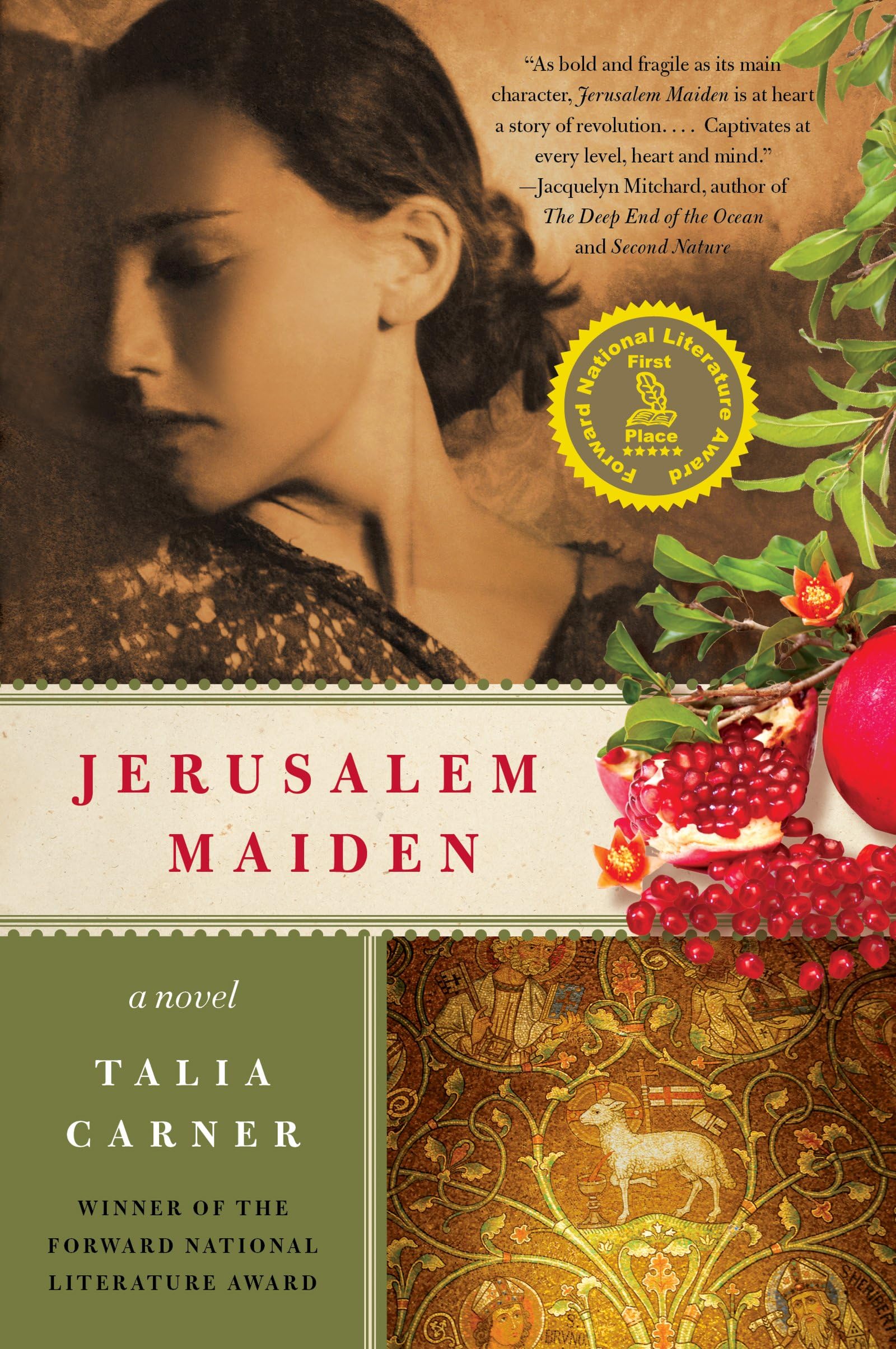
Jerusalem Maiden: A Historical Novel of How a Jewish Woman's Art Defies Faith in Early 20th-Century Ottoman Jerusalem
Product ID: 1693135
Buy anything from 5,000+ international stores. One checkout price. No surprise fees. Join 2M+ shoppers on Desertcart.
Desertcart purchases this item on your behalf and handles shipping, customs, and support to Lithuania.
“Talia Carner is a skillful and heartfelt storyteller who takes the reader on journey of the senses, into a world long forgotten.” —Jennifer Lauck, author of Blackbird “Exquisitely told, with details so vivid you can almost taste the food and hear the voices….A moving and utterly captivating novel that I will be thinking about for a long, long time.” —Tess Gerritsen, author of The Silent Girl “Talia Carner’s story captivates at every level, heart and mind.” —Jacquelyn Mitchard, author of The Deep End of the Ocean The poignant, colorful, and unforgettable story of a young woman in early 20th-century Jerusalem who must choose between her faith and her passion, Jerusalem Maiden heralds the arrival of a magnificent new literary voice, Talia Carner. In the bestselling vein of The Red Tent, The Kite Runner , and A Thousand Splendid Suns , Jerusalem Maiden brilliantly evokes the sights and sounds of the Middle East during the final days of the Ottoman Empire. Historical fiction and Bible lovers will be captivated by this thrilling tale of a young Jewish woman during a fascinating era, her inner struggle with breaking the Second Commandment, and her ultimate transcendence through self-discovery. Review: A Work of Genius, Breathtaking and Haunting - I am a fan of author Talia Carner, having read both of her earlier novels, CHINA DOLL and PUPPET CHILD. I thought that both of those books were brilliant and JERUSALEM MAIDEN is even more so. From prior experience, I know that Ms. Carner's stories are haunting; these stay with the reader for years and years. After those two earlier important works, Ms. Carner has outdone herself in this latest effort. Years ago, the great sagas respectfully were said to cross oceans and spread over decades. In that tradition of the greatest sagas, JERUSALEM MAIDEN does both. The novel's heroine is Esther, a young girl who is born into an ultra-Orthodox Jewish family which has moved (back) to the Holy Land after millennia in the Diaspora. Author Carner does a magnificent job of explaining the Orthodox lifestyle, with its numerous rules governing every aspect of daily life, and its restrictions, which are almost as numerous. Set in turn of the 20th Century Jerusalem, JERUSALEM MAIDEN is a history of how hard life was in that place and time. There were constant attacks by bands of Arab enemies and the very chores of everyday existence, by modern standards, were harshly tedious. Factor in the almost infinite religious requirements and that life was unimaginably difficult. The conflict comes when there is someone -- here, Esther -- who is not blindly accepting of the laws of her faith; who, in fact, has been blessed with a talent which her faith condemns and prohibits. Esther discovers that she is a gifted artist. As such, she would prefer to move beyond her preordained existence as a homemaker (a tough lot in that time and place), wife and mother to follow her passion and study painting. Can Esther reconcile her religion, and the strong obligation she feels for its many tenets, with a career as a fine artist? Carner does a magnificent job of telling this story, of showcasing this important underlying conflict. In the process, she has written a novel that is riveting, informative and touching. Talia Carner has entered the ranks of the greatest Jewish storytellers, along with Sholom Alecheim, Issac Bashevis Singer and Chaim Potok. JERUSALEM MAIDEN deserves to win every writing prize. Review: forbidden art - I thorougly enjoyed this wonderful novel about a young girl in the ultra orthodox community of haredi Jews at the turn of the century Jerusalem. Talia Camer write very well, and the story includes fabulous painterly descriptions of very primitive living at the turn of the twentieth century when many children died of illness before their fifth birthday and women died in childbirth. The scenes of artistic Paris life, and Jewish life in the Marais are also brilliantly described. Will our heroine Esther find happiness with a demandinGod whose strict rules she tries to fight against? Read this beautifully written novel to find out


| Best Sellers Rank | #183,954 in Books ( See Top 100 in Books ) #317 in Jewish Literature & Fiction #638 in Cultural Heritage Fiction #10,277 in Literary Fiction (Books) |
| Customer Reviews | 4.4 out of 5 stars 1,262 Reviews |
H**Y
A Work of Genius, Breathtaking and Haunting
I am a fan of author Talia Carner, having read both of her earlier novels, CHINA DOLL and PUPPET CHILD. I thought that both of those books were brilliant and JERUSALEM MAIDEN is even more so. From prior experience, I know that Ms. Carner's stories are haunting; these stay with the reader for years and years. After those two earlier important works, Ms. Carner has outdone herself in this latest effort. Years ago, the great sagas respectfully were said to cross oceans and spread over decades. In that tradition of the greatest sagas, JERUSALEM MAIDEN does both. The novel's heroine is Esther, a young girl who is born into an ultra-Orthodox Jewish family which has moved (back) to the Holy Land after millennia in the Diaspora. Author Carner does a magnificent job of explaining the Orthodox lifestyle, with its numerous rules governing every aspect of daily life, and its restrictions, which are almost as numerous. Set in turn of the 20th Century Jerusalem, JERUSALEM MAIDEN is a history of how hard life was in that place and time. There were constant attacks by bands of Arab enemies and the very chores of everyday existence, by modern standards, were harshly tedious. Factor in the almost infinite religious requirements and that life was unimaginably difficult. The conflict comes when there is someone -- here, Esther -- who is not blindly accepting of the laws of her faith; who, in fact, has been blessed with a talent which her faith condemns and prohibits. Esther discovers that she is a gifted artist. As such, she would prefer to move beyond her preordained existence as a homemaker (a tough lot in that time and place), wife and mother to follow her passion and study painting. Can Esther reconcile her religion, and the strong obligation she feels for its many tenets, with a career as a fine artist? Carner does a magnificent job of telling this story, of showcasing this important underlying conflict. In the process, she has written a novel that is riveting, informative and touching. Talia Carner has entered the ranks of the greatest Jewish storytellers, along with Sholom Alecheim, Issac Bashevis Singer and Chaim Potok. JERUSALEM MAIDEN deserves to win every writing prize.
M**S
forbidden art
I thorougly enjoyed this wonderful novel about a young girl in the ultra orthodox community of haredi Jews at the turn of the century Jerusalem. Talia Camer write very well, and the story includes fabulous painterly descriptions of very primitive living at the turn of the twentieth century when many children died of illness before their fifth birthday and women died in childbirth. The scenes of artistic Paris life, and Jewish life in the Marais are also brilliantly described. Will our heroine Esther find happiness with a demandinGod whose strict rules she tries to fight against? Read this beautifully written novel to find out
L**T
The Story of Eshter
Paula E. Hyman, in her scholarly treatment of “Gender and Assimilation in Modern Jewish History: The Roles and Representation of Women,” argues, “Women’s history has altered our understanding of the nature and definition of community among Jews and has revealed hitherto unrecognized complexities in the issue of assimilation. In Talia Carner’s best selling novel “Jerusalem Maiden” Her main character, Esther Kaminsky, goes through her life changing her understanding of community underscoring Hyman’s thesis. As she moves from a little girl to a grown woman and beyond, her perception of Judaism changes as her perception of life changes. In other words, she becomes less religious and more modern, the absolute definition of assimilation. The issue of the religious Jew struggling with modernity, to take part in the world but still hold true to God’s word is a common theme running through Jewish literature for the last 150 years. This, like Carner’s character says more about the Jewish experience in general than it does about any one specific character in a story. Since the beginning of the Haskalah, (Enlightenment) Jews have been forced to make the choice of living in the world and becoming part of it, or living on the side lines and watching it. The examples of this in literature are numerous, Shalom Aleichem’s “Tevye’s Daughters,” better known through the Norman Jewison film, “Fiddler on the Roof,” tells of a father’s dilemma marrying off his daughters colliding tradition with modern living. Chaim Potok’s “The Chosen” follows an Hasidic boy who’s genius leads him through god’s hand to leave his community and study the secular world of Freudian psychology. Even a post modern approach of the film, “American Pop,” by Ralph Bakshi uses four generations of American Jews to go from the Hasid, an ear locks bearing immigrant in 1890’s America to a 1980s street tough in New York city making bank through selling drugs and dealing in common street crime. You have to know Bakshi to understand the connection to Jewish culture this has and how this theme plays perfectly into Jewish literature. In each of those examples there’s a defining element which drives the character to move into a more modern, less religious and emancipated life. For Carner, she uses the fine art of painting on canvas to drive her character. Esther rethinks every belief she had known growing up to find her place in the world to which she can be comfortable as a modern human being while still searching and finding grace in her own Jewish identity. All the while, she follows the natural urges to paint, to love, and to live in the world of 1920’s Europe. Esther ends up a million light years away from Mea Shararim, her community where she grew up, nestled away in the winding serpentine streets and alley ways of early 20th century Jerusalem, purposely shut off from the rest of the world while waiting for the Messiah. Esther liberates herself, artistically through her art, sexually through a young French artist who she cannot resist even to the point where she abandon’s her family, divorces her husband and becomes part of the bohemian lifestyle of pre world war II Paris. A fifteen to twenty year transition Esther becomes the woman she knows she has to become. Carner leaves Esther no choice. Her personal freedom must be got, and she knows it. The author does an excellent job juxtaposing the grainy black and white world of an all encompassing, religious existence with the colorful, sexually free, libertine, life in 1920s modern Paris. It was called “Gay Paris” for a reason. Now we have a different definition of that word “Gay” but then it meant happy, fulfilled, and joyous nature for someone of Esther’s spirit with the liberated aspect of one of the great art movements of 1920s western civilization. As a grown woman in Paris, her personality and her zeal to create something that was not God, but man, left her no choice but to regard her upbringing as suffocating, and this world as enlightening. Carner takes us on a journey not only through time but through existential thought running the gambit from one extreme of life to the other. Such a dramatic change might have broken weaker personalities, but Carner’s Esther has her art which she transverses her religious belief and this is what saves her. The end of the book I will not reveal so as to not to spoil it, but it brings together this notion of the Jewish struggle to belong as mentioned earlier with all of its rewards and consequences. Within that struggle lies the strength of the Jewish people to adapt to their surroundings throughout their history. It might be one of the reasons why the Jews have survived and the ancient peoples they were born alongside have long since disappeared. Carner brings this to life in her book. And, that ending—well—read it, and you will understand.
R**Y
The burden of organized religion can be overwhelming
Many in the modern world believe that Muslim females are abused by virtue of the requirement that they wear clothing that totally covers them, while the women who wear the garb insist that they are just honoring their religion and do not feel oppressed. The issue is whether or not these women have been indoctrinated during their childhood so as to believe that doing or not doing things they were taught meant something significant under the religious rules they were taught they had little or no choice but to accept and honor. I mention this as this book has minimal value in its text save for the very clear reinforcement of the argument that religion, when carried to an extreme, indoctrinates and actually denies its followers the utilization of the very self will that, if there is a god, he/she granted them. I found it hard to read the book after about 18% completion at which point I was ready to quit reading as I felt so sorry for the youthful female children of the Jewish family (yes orthodox religious Jews and ultra religious Muslims are very much the same in many respects, and certainly as to how women are treated (mistreated). Perhaps the book has other messages that I missed out of inability to remove from my mind how sorry I felt for Esther, a young girl, who was frustrated in her attempt to draw (she having the talent to draw and paint) and understand why it was that daddy told her that her role in life was not to draw as only god can create, and that her job was to be a wife to whomever he chose for her to marry. So in conclusion reading this book will not enable the reader to justify any form of prejudice or disdain of those who choose to live in accordance with their religion, no matter how silly so much of it may seem in the modern age, but it does make one think about the impact it has upon women and how much of a better world we would have if the women who were indoctrinated as children had the ability to exercise their self will and create, speak up, and engage the world and its occupants, male and female, as they saw fit. The best part of the book, which is well written and easy to read, and is enjoyable as well as educational, was that the woman heroine who was so indoctrinated found her way to real life though love of a man who bought her such pleasure that she simply assumed that her god had delivered him and her artistic talent to her and that enabled her to overcome the restraints organized religion had imposed. The lessen from the book is that we are humans who have emotions, physical needs, and desires that do not always fit together with the stringent often seemingly ridiculous rules imposed by church leaders who contend the rules came not from them but from God, and the sad part is how many people accept that as factual and miss out on lifes pleasures and the freedom that comes from self will if allowed to be exercised.
N**R
What's with the strange sex scenes?
This book is fine. The descriptions of Israel are interesting, as are the rituals, etc. But I found the character development lacking, the story plodding, and could not figure out why there needed to be the odd sex scenes that I encountered. I also, as an English teacher, found myself wanting to correct grammar and syntax that could have been edited to be stronger and tighter. A good concept and an interesting premise, but I found it to be very vanilla. And the sex, which felt as though it was added in order to "spice it up," fell flat and seemed gratuitous. Let's just say that when I discovered I wasn't going to be able to attend the Book Club meeting for which I read the book, I really felt as though I'd wasted my time for nothing.
K**F
Jerusalem Miracles
JERUSALEM MAIDEN (Talia Carner) transports me back to a trip to the Holy Land in 2010. My brother Frederic, sits in a wheelchair, attended by Nasser, our Muslim guide, a Sephardic rabbi blesses his prayer shawl, folds it properly over his shoulders, Frederic's Green Beret covers his hair pulled back in a Willie Nelson ponytail. Sunglasses shade the pain in his eyes. The trip was celebrating my retirement, his daughter Rojji's college graduation, & my brother's commemorative jump into Holland freeing the Dutch in WW2. The day we left Dallas, still in the hospital, Frederic removed the IV from his arm, and we took a taxi to the airport to fly to Tel Aviv. When we landed, Frederic's toe wrapped with honey stopped hemorrhaging from a low platelet count. A miraculous healing. One miracle followed another until we returned to Dallas fourteen days later. JERUSALEM MAIDEN Esther's journey is filled with similar miracles from the small town in Israel to Paris. Beginning her quest for beauty, Esther turns to face a "despicable dog, his yellow-gray teeth exposed," she waves her arms, fearing disease, then flails her arms, a "snarl rising from her chest, tearing her throat, as the animal backed off, tucking its tail and slinking away." Miracles follow, Esther facing challenges with friends by her side--tempting and teaching her: Mlle Thibaux, the art teacher who gave her the gift of beauty--azure, Prussian, cobalt, cerulean, sapphire, indigo, lapis. Her Aba father, wearing a long red beard, teaches her Talmud, arithmetic, English. Nathan her secular Jewish husband gives her children. Asher, her homosexual cousin's gift-- music, "to lift her up, floating past monastery ruins, fig trees, to her art teacher's encouraging smile, Esther's canvases, paints, linseed oil." Pierre, Thibaux's bastard artist son, tempts her to taste sins of the flesh. Even the Arab whom she bit when he tried to rape her teaches perseverance. Esther at the beach in Tel Aviv, "takes off her sandals, to feel the fine sand, the soles of her feet losing the leathery crust of her youth, and feats on the spectacle of colors--years ago discovering `blue.'" Now seeing the Mediterranean, she sees the nuances of aqua blue turning translucent, precious-emerald green gleaming under the surface. Foam undulates on top like a lacy veil. The sound of the sea, a "lapping, lulling nigun." Esther, drawn to Paris and eventually to the Saint-Sulpice Church, searching for Delacroix's work, hears "chink, chink, chink," and discovers a shirtless artist, his "shiny skin burned to a deep tan, smooth muscles knotted rhythmically with his body movements," sits to ease aching calves, then goes to splash water on her face, to recoil at Pierre, the sculptor, standing over her. She fights with herself, in love with a goy, and the reader holds her breath to see where her journey leads her. A "pale gecko on a chiseled stone window sill scans the room with staccato movements." Esther paints and comes to enjoy God in a new light, as confusion fills her life with more sorrow. Talia Carner includes the Yiddish proverb in her story--A person should want to live if only out of curiosity. Not able to summon curiosity or strength, Ether's friend commits suicide. Esther, however, remains strong and true to herself. My brother's words, Please help me. Don't let me die, told his wish to live, even in the painful tragedy of his life. I held him, watching the light leave his eyes. Esther's eyes fill with hope in her journey to Israel to find herself and reclaim her artist's light.
M**P
engaging and compelling
an engaging well written story. It describes the pull of multiple coexisting yet divergent passions -the intense depths of pain and pleasure, happiness and sorrow and the difficult choices we make for ourselves and those we love. It illuminates different types of love and our sense of responsibility to many different people, ideas and ideals while struggling with what it means to be true to ourselves and others
L**T
Fascinating and Well Researched
Jerusalem Maiden by Talia Carner is a fascinating and well-researched book. The story and characters kept my interest throughout. The author brings to life the particular culture of the ultra-Orthodox Jews in Jerusalem during the early part of the 20th century and emphasizes the stifling role of women in that society, particularly women with creative minds and talents. My research into shtetl life in Eastern Europe during the same time period suggests that the attitudes toward and expectations of women were similar among Jewish communities in other regions. Carner has done a superb job bringing to life the environment of the times and depicting the atmosphere within which Esther struggled with her need for creative expression. My only disappointment in reading the book was my feeling that Esther's choices did not always seem believable, especially her behavior when in Paris. Nevertheless, Carner conveys the ambivalence and guilt a woman in her circumstances must have felt. I would definitely recommend this book to lovers of historical fiction.
C**B
Extremely well written historical novel, before Israel was formed.
Such an interesting historical novel. I’m learning so much about Jewish customs, and the expectations for, and the struggles of, a young woman under the extreme pressures of religion and the times. Also like learning about the country before it became the Israel of today. It’s extremely well written.
M**B
Captivating!
A very strong story, the focus is on one character so you don't loose track of what's going on. I read it three times by now and will read again, writing is fluent and pleasant.
C**R
Jerusalem Maiden. A book to think about for months afterwards.
Jerusalem Maiden. Interesting book. Can recommend, especially if you like art and/orParis. About an arranged marriage in the waning days of the Ottoman empire.
T**Y
Well written.
The story was compelling,describing a young girl's life in an ultra-orthodox early 20th century Jerusalem home. The struggle to remain true to her upbringing and to fulfill her artistic yearnings was chronicled in a very convincing manner. I would recommend this book.
N**O
Great book. Had to finish in a day!
Amazing book about a determined young girl.
Trustpilot
1 month ago
4 days ago