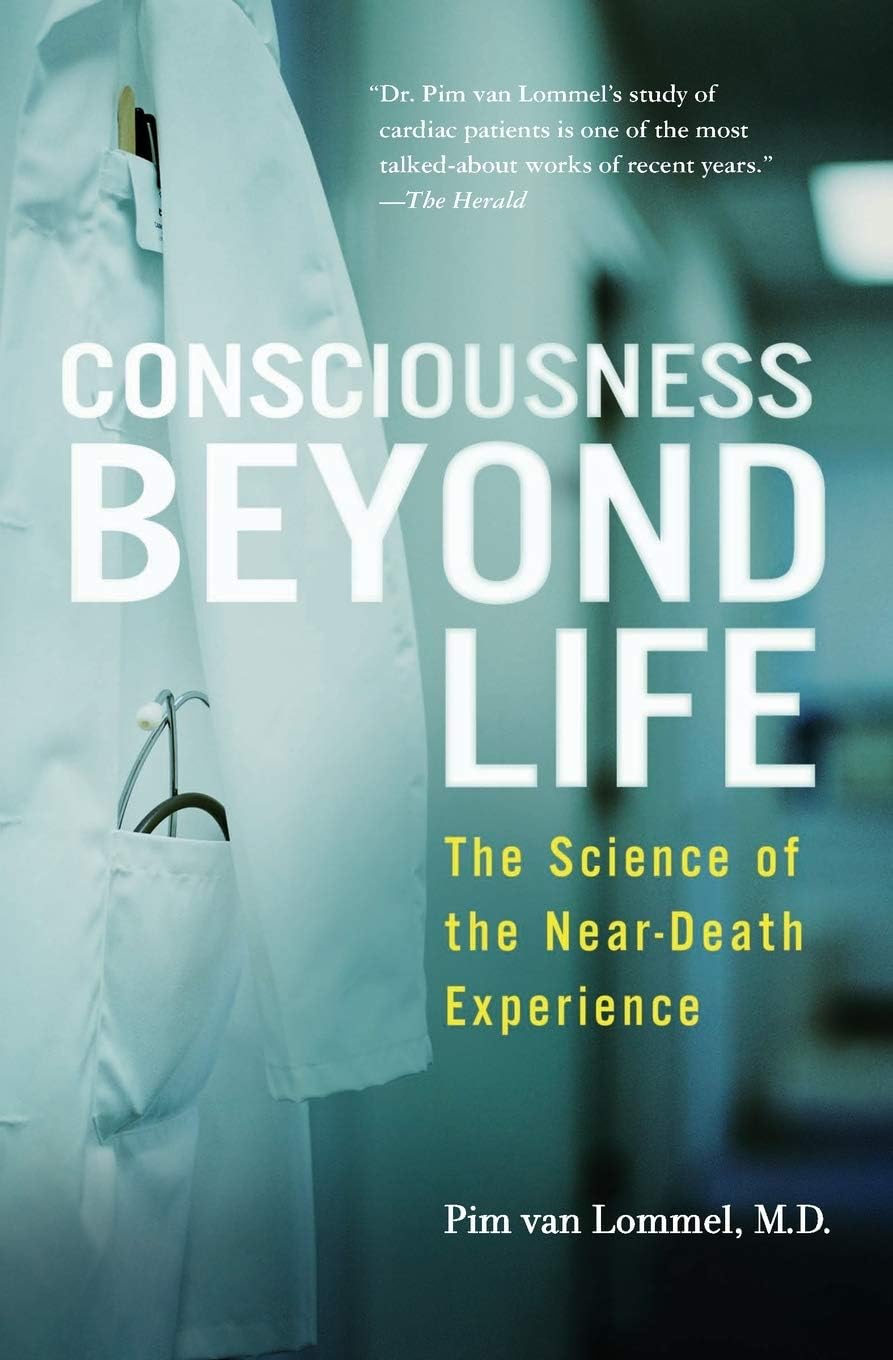
Consciousness Beyond Life: The Science of the Near-Death Experience
Product ID: 13201994
Buy anything from 5,000+ international stores. One checkout price. No surprise fees. Join 2M+ shoppers on Desertcart.
Desertcart purchases this item on your behalf and handles shipping, customs, and support to Lithuania.
In Consciousness Beyond Life , the internationally renowned cardiologist Dr. Pim van Lommel offers ground-breaking research into whether or not our consciousness survives the death of our body. If you enjoy books about near-death experiences, such as those by Raymond Moody, Jeffrey Long, and James Van Praagh; watch televisions shows like Ghosthunters, Touched by an Angel , and Ghost Whisperer ; or are interested in works that explore the intersection of faith and science, such as Spiritual Brain, Signature in the Cell , and When Science Meets Religion ; you’ll find much to ponder in Consciousness Beyond Life . Review: Van Lommel's uses quantum mechanics to conceptualize consciousness & are clear and challenging. - This is an important book for anyone who is interested to consider the survival of consciousness after death. Dr. Lommel is a credible source, due to his many years experience in a clinical setting. Also, the book is comprehensive and clearly written. It is thoroughly footnoted and exhaustively researched, but the chief attribute of the book is it's accessible writing style and fascinating readability. Pim van Lommel has impeccable credentials in his field and he is also a first-rate storyteller. This is a book that is literally hard to put down. People who experience a near death experience (NDE) often feel alone and may encounter negative feedback from their family and friends. This excellent book was written by a cardiologist who has not had an NDE but rather kept hearing about the experiences from patients. He then conducted several studies, well-designed, that convinced him NDEs are absolutely real. If you have questions about what happens when we die, read this book. If you are skeptical about "near death experienced", read this book. Some parts are a bit scientific in language, but the book is very approachable for all people. The book mainly focuses on the scientific evaluation of a seemingly unscientific phenomena - the near death experiences. Still, it covers a variety of modern researches and theories concerning life and consciousness through NDEs, which makes it at least an interesting, revealing, and thought-provoking reading experience. The writing itself was accessible and thoughtful. Just prepare to be very open-minded. And now I am extremely curious about what science would take us in the future for sure! I enjoy research so having all his references presented means a layman like me can check it out for myself. I didn't notice any religious babble...just facts and theories. My take on the book is...the mind is not the body so nobody dies. Now what? I love the way how the author explains how quantum physics begins to throw light on these things. It can't really be fully explained to our mind limited as it is by time and space and bodily identification but... Also we so much appreciate the good work and research of so many including David Bohm. And for myself, I love how much of the ancient wisdom texts (Advaita Vedanta) concord with NDEs and quantum physics. If you want to really know if this book is for you, go to your local library. If they don't have a copy there is always the option of the Inter-Library Loan procedure (books usually take about 3 weeks to arrive). I almost always preview books from the library before purchasing ... it has saved a lot of disappointment. Review: An interesting and highly informative book you may want to check out. I loved it. - As someone well into their senior years I have been a voracious reader for more than 7 decades. My interests have ranged from A to Z and from the traditional hard core scientific to the often strange and weird esoteric. This is why while browsing on desertcart when I came across this 422-page soft cover book (Consciousness beyond life: The science of near-death experience by Pim Van Lommel, M.D.) I decided to purchase it. Unlike many other books on this topic, this one is written by a scientifically trained medical doctor who is also open minded enough to not dismiss the thousands of cases all over the world involving out-of-body experiences. Some of the many fascinating areas covered in this book includes the following: “A near-death experience and its impact on life, what is a near-death experience, changed by a near-death experience, near-death experiences in childhood, research into near-death experiences, what happens in the brain when the heart suddenly stops, quantum physics and consciousness, endless consciousness” and other topics. This is an educational and thought-provoking book for anyone who is interested in near-death experiences. I loved it. Rating: 5 Stars. Joseph J. Truncale (Author: Season of the warrior: A poetic tribute to warriors).
| Best Sellers Rank | #170,917 in Books ( See Top 100 in Books ) #92 in Near-Death Experiences (Books) #249 in Consciousness & Thought Philosophy #746 in Personal Transformation Self-Help |
| Customer Reviews | 4.5 out of 5 stars 800 Reviews |
P**N
Van Lommel's uses quantum mechanics to conceptualize consciousness & are clear and challenging.
This is an important book for anyone who is interested to consider the survival of consciousness after death. Dr. Lommel is a credible source, due to his many years experience in a clinical setting. Also, the book is comprehensive and clearly written. It is thoroughly footnoted and exhaustively researched, but the chief attribute of the book is it's accessible writing style and fascinating readability. Pim van Lommel has impeccable credentials in his field and he is also a first-rate storyteller. This is a book that is literally hard to put down. People who experience a near death experience (NDE) often feel alone and may encounter negative feedback from their family and friends. This excellent book was written by a cardiologist who has not had an NDE but rather kept hearing about the experiences from patients. He then conducted several studies, well-designed, that convinced him NDEs are absolutely real. If you have questions about what happens when we die, read this book. If you are skeptical about "near death experienced", read this book. Some parts are a bit scientific in language, but the book is very approachable for all people. The book mainly focuses on the scientific evaluation of a seemingly unscientific phenomena - the near death experiences. Still, it covers a variety of modern researches and theories concerning life and consciousness through NDEs, which makes it at least an interesting, revealing, and thought-provoking reading experience. The writing itself was accessible and thoughtful. Just prepare to be very open-minded. And now I am extremely curious about what science would take us in the future for sure! I enjoy research so having all his references presented means a layman like me can check it out for myself. I didn't notice any religious babble...just facts and theories. My take on the book is...the mind is not the body so nobody dies. Now what? I love the way how the author explains how quantum physics begins to throw light on these things. It can't really be fully explained to our mind limited as it is by time and space and bodily identification but... Also we so much appreciate the good work and research of so many including David Bohm. And for myself, I love how much of the ancient wisdom texts (Advaita Vedanta) concord with NDEs and quantum physics. If you want to really know if this book is for you, go to your local library. If they don't have a copy there is always the option of the Inter-Library Loan procedure (books usually take about 3 weeks to arrive). I almost always preview books from the library before purchasing ... it has saved a lot of disappointment.
J**E
An interesting and highly informative book you may want to check out. I loved it.
As someone well into their senior years I have been a voracious reader for more than 7 decades. My interests have ranged from A to Z and from the traditional hard core scientific to the often strange and weird esoteric. This is why while browsing on Amazon when I came across this 422-page soft cover book (Consciousness beyond life: The science of near-death experience by Pim Van Lommel, M.D.) I decided to purchase it. Unlike many other books on this topic, this one is written by a scientifically trained medical doctor who is also open minded enough to not dismiss the thousands of cases all over the world involving out-of-body experiences. Some of the many fascinating areas covered in this book includes the following: “A near-death experience and its impact on life, what is a near-death experience, changed by a near-death experience, near-death experiences in childhood, research into near-death experiences, what happens in the brain when the heart suddenly stops, quantum physics and consciousness, endless consciousness” and other topics. This is an educational and thought-provoking book for anyone who is interested in near-death experiences. I loved it. Rating: 5 Stars. Joseph J. Truncale (Author: Season of the warrior: A poetic tribute to warriors).
S**E
Science Heavy
Dr. Pim van Lommel's Consciousness Beyond Life seemed to be two books in one. What seemed to me to be the first part, chapters 1 through 10, deals exclusively with Near Death Experiences (henceforth NDE). Lommel does an excellent job of relating all the aspects of NDEs and demonstrates why many of them cannot be accounted for by any naturalistic hypothesis. What's most important and unique to Lommel's book is his own Dutch study of NDEs that spanned almost a decade. Lommel provides accounts of numerous NDEs that contained veridical evidence. In fact, this book is worth the money just to simply read some of these amazing stories. Also important is that Lommel's study was prospective and therefore had a control (patients who went into cardiac arrest and did not have a NDE). This prospective study demonstrates that neither physiological, psychological nor pharmacological explanations could have played a factor in the NDEs. Lommel also brings forth the statistics of his study and demonstrates that NDEs are found across people with varying beliefs, backgrounds, religions, social status etc. and shows that there is no difference between patients who experienced an NDE and ones who did not. Another important aspect of Lommel's book is his discussion of why no type of brain activity can account for an NDE. He demonstrates that consciousness is dependent on the cerebral cortex, brain stem, and communication between the hippocampus and thalamus and that these are the first parts of the brain to go during a cardiac arrest. Thus, many "skeptic" explanations such as oxygen deficiency, chemical reactions in the brain, and electrical activity in the brain are unwarranted and cannot account for experiences during an NDE. What I take to be the second part of this book, chapters 11 through 16, are quite scientifically advanced and, surprisingly, less concrete. Lommel utilizes current Quantum Theory (e.g, nonlocality, entanglement) to outline and defend a widely-known, but not widely-held, theory which he calls nonlocal consciousness. I will not expand the theory here since I have neither the space nor the nonlocal consciousness to do so (insert laughter here) but I will say that this theory entails that matter is contingent on a sort of other-dimensional omnipresent consciousness. The problem I had with this section is that it went a little over my head. However, what I did understand seemed fascinating and shocking (in a good fashion). Lommel's theory, unfortunately, is too conjectural for now anyway. But he should be commended for his unique theory and only time will tell if it's warranted. All in all, this is a fantastic book. Even if one is not enlightened to all the science in it one will inevitably benefit from the first part on NDEs. I recommend this book to all interested in NDEs or the current debates regarding the genesis and nature of consciousness.
T**E
A One Volume Education
Mr. van Lommel has, in this book, put together a one stop overview of the NDE. NDEs are ready to give our culture what it dearly needs- a view of spirituality that avoids the dogma and superstitious platitudes of religion. Science as it is practiced fumbles with the magnitude and life-changing scope of the NDE, either attempting to reduce it to one of its infamous 'nothing buts' or ignoring it altogether. But van Lommel is a long practicing surgeon, and knows what he's talking about when he tells us that the phenomenon is not reducible to mere hallucination or fantasy. This book covers the subject, and well, from what history has to tell us about the NDE to the medical aspects, and the effects to the experiencer as well- all in a clear, grounded manner that still shows his awe at what the NDE is pointing towards. Van Lommel, despite his authority, knows he's well over his head here, as are we all, but he does an admirable job documenting what we know, and what we can know. If you only read one book on NDEs, this would be a good candidate. The only flaw is that I think he could have included more actual NDE accounts. For those, I'd suggest going to NDERF.ORG and reading some of the page 'extraordinary NDEs'. Amazing, life changing stories. I've read several hundred and can easily say they've changed my life by just reading them- I can only imagine what it's like to have one, and I'm thinking that one day I shall, as will we all, even if we must remove the 'N'! What an amazing reality we live in. Sometimes it's hard to see that- if we could only get a glimpse of the Other Side- and we can, in a way, by studying this most profound of human events. Materialism threatens our world with its nihilism. It's time we all educated ourselves and took up arms against this pernicious philosophy. The study of NDEs is a very powerful tool to this end, and this is perhaps the single best book on the subject. Check out Chris Carter's books as well.
C**T
The New Standard for NDE Research: Amazing
The most compelling, rigorous study of NDEs I’ve read in over a decade of learning about this topic. There is an entire chapter devoted to methodology; I found this fascinating because Dr Lommel excluded retrospective accounts in favor of prospective accounts that could more readily be verified; retrospective retelling is more prone to faulty memory. Also, an entire chapter devoted to the structure and function of the human brain. And then the abundance of actual NDE stories; some of the out of body experiences are absolutely stunning: imagine seeing your own body from above the operating table and seeing/ hearing everything without the aid of bodily sense organs: eyes/ ears. Just imagine the implication of this conclusion: “Lucid consciousness is possible outside the brain and body”
M**N
Touches all bases
It is difficult to understand how mainstream science can continue to ignore or reject the implications of the near-death experience (NDE) in light of the evidence and arguments made by Dr. Pim van Lommel in this most comprehensive book. Dr. van Lommel seemingly touches all bases in exploring the various phenomena related to the NDE. Having grown up in an academic environment, van Lommel, a world-renowned cardiologist practicing in The Netherlands, writes that he was of the reductionist and materialistic mindset before he began studying the NDE and the nature of consciousness. He has closely examined all the arguments made by the scientific fundamentalists and now has a more positive outlook. "That death is the end used to be my own belief," he writes. "But after many years of critical research into the stories of the NDErs, and after a careful exploration of current knowledge about brain function, consciousness, and some basic principles of quantum physics, my views have undergone a complete transformation. As a doctor and researcher, I found the most significant finding to be the conclusion of one NDEr: `Dead turned out to be not dead.' I now see the continuity of our consciousness after the death of our physical body as a very real possibility." About the time I started reading this book, reports were appearing at various internet sites stating that there is now evidence that the NDE is nothing more than a brief spell of abnormal brain activity resulting from oxygen deficiency. This theory has been going around for years, but seems to get resurrected every few years as if it is new science. Van Lommel dismisses the theory, pointing out that the NDE is "accompanied by an enhanced and lucid consciousness with memories and because it can also be experienced under circumstances such as an imminent traffic accident or a depression, neither of which involves oxygen deficiency." Van Lommel also addresses the skeptic's theory about the tunnel effect reported by many NDErs being caused by the disruption of oxygen supply to the eye, which gradually darkens one's range of vision. He points out that such a theory cannot explain the reports by NDErs that say that they meet deceased relatives in the tunnel. He tells why carbon dioxide overload, various chemicals, and other physiological theories do not account for the NDE. "When new ideas do not fit the generally accepted (materialist) paradigm, many scientists perceive them as a threat," van Lommel writes. "It is hardly surprising therefore that when empirical studies reveal new phenomena or facts that are inconsistent with the prevailing scientific paradigm, they are usually denied, suppressed, or even ridiculed." A chapter of the book is devoted to quantum theory, which includes non-locality, or the idea that the mind operates outside of time and space and that what we in the physical plane interpret as reality is not reality at all. As van Lommel sees it, many aspects of the NDE correspond with or are analogous to some of the basic principles from quantum theory. "The findings of NDE research suggest the possibility that (nonlocal) consciousness is present at all time and will therefore last forever," van Lommel offers. "The content of a near-death experience suggests a continuity of consciousness that can be experienced independently of the body." Something I have found particularly troubling over the years is the possibility that organs are being harvested before bodies are actually "dead," even though the person might be pronounced "clinically dead." Van Lommel devotes several interesting pages to the debate on this subject, pointing out that when brain death has been diagnosed, 96 percent of the body is still alive. While not in principle opposed to organ transplants, van Lommel suggests that more consideration should be given to the nonphysical aspects of organ donation, including the fear of death. Over the past 35 years, NDE researchers like Drs. Raymond Moody, Kenneth Ring, Michael Sabom, Bruce Greyson, Melvin Morse, and others have build a very solid wheel, one that supports the survival hypothesis. Close-minded skeptics keep trying to make the wheel collapse by bending the spokes. Fortunately, we have newer researchers like Drs. van Lommel and Jeffrey Long ("Evidence of the Afterlife") coming along to demonstrate that the spokes are solid and the wheel secure.
H**G
Some interesting thoughts, but hurts its credibility
I'm a skeptic, but completely open to some of the ideas in this book... the problem I have is that the author cites utterly unproven or entirely absurd "research" to support his ideas that DNA is some kind of quantum antenna to the life force of universal consciousness. For instance, he off-handedly mentions a Chinese experiment where blindfolded children managed to teleport small objects with their minds. Could you imagine the revolution in science there would be if such a thing actually happened? It worries me that the author believes this "study" is true. He also cites white blood cells that have some kind of sympathetic bond with miles between them, so actions against one set of cells elicits a response in the others. I call BS on this, too. I'd be willing to bet any such simultaneous change is nothing more than randomness being studied by people who have very loose standards guarding against confirmation bias. He also states that telekinesis is a real thing. Well, no, it's not. Whenever it's been tested with some scrutiny, it's either been a scammer softly blowing on an object or using magnets. In short, it's a magic trick. Like I said, I find the notion of some kind of "consciousness field" to be interesting, but his "proof" is based on the wildest of suppositions, although he wraps it in "quantum theory" -- the latest buzz phrase to explain all manners of magical thinking -- but quantum objects doing "spooky" things does not mean consciousness is part of it. The writer's line of thinking is "since it's unknown, it must support my suppositions." Bad science. Really bad. I support scientifically studying whether consciousness can exist outside the body. It's fascinating and I'd really like it to be true -- but there is no proof. He points to the government project for remote viewing as some kind of evidence, but I've studied that project too; it's not all that. Their results were overwhelmingly poor and the few "good" hits were done under very dubious conditions. The good hits you've heard of came at the very end of their tenure, so after they knew they might not get funded for another year. A little suspicious. And the men running it weren't the strictest scientists and managed to be funded for so long because the government mostly ignored them and their budget was relatively tiny for the Defense department. Sorry for so many words, but the short of it is that the writer comes across as a man of science and critical thinking, but he is too quick to believe ridiculous claims because it serves his thesis that consciousness is a field accessed by living things. This book isn't science; it's dubious speculation.
K**R
Astonishing and Breathtaking
In Consciousness Beyond Life, Pim van Lommel makes a strong case for what he calls nonlocal consciousness or continuous consciousness, the idea that a higher form of consciousness exists apart from the brain or the ego. He does this by referencing several studies into Near Death Experiences (NDEs), perimortem and postmortem experiences by the living of (the consciousness of) the dying or recently dead, remote viewing, telekinesis and similar phenomena of consciousness beyond our familiar waking consciousness. In addition to studies, he references surveys of populations around the world of people who have experienced these things personally. He introduces basic concepts of Quantum Physics principles such as entanglement and nonlocality, in layman's terms, to provide a possible explanation of this controversial topic from a more scientific viewpoint. I was expecting a more anecdotal survey of such experiences like most books I have read about NDEs. I was pleasantly surprised to find this author's approach far more satisfying. This book not only makes you think, it often takes your breath away. His "survey course" on the nonlocal properties of DNA alone is worth the price of the book. Chapter 10, the one lengthy description of an NDR's experience was truly mind expanding, unforgettable! I also enjoyed his inclusion of ancient historical descriptions of continuous consciousness from the Hindu Upanishads, Tibetan Buddhist texts and the Bible. I confess I did skim through the more complex discussions of physics, but van Lommel kindly informs the reader when such a section is coming up and invites us to skip these if we choose to. There is also a lot of repetition, especially of statistical data resulting from his studies, but again, these factoids are easily breezed through and in no way detracted from my enjoyment of the book. An overriding theme of the book is to challenge the moribund adherence of the scientific community to a purely materialistic explanation of consciousness. He invites these scientists to open their minds to another possibility. He refers more than once to the concept that even one anomaly to the accepted dogma of the machinistic approach to human consciousness should be enough to engender another look at the question. I will not soon forget this book. If you have ever wondered if the reality we perceive is all that there is, if you feel another dimension existing alongside your everyday existence, if you seek to explore the nature of life and death, I highly recommend that you plunge headfirst into this astonishing work.
A**A
Is there an end?
A meticulously documented study into consciousness after official death as determined by modern medical science. Much more than the typical NDE (near death experience) book.
J**P
conciencia ahora y por siempre
Los druidas ya decían que el alma precede al cuerpo y sigue existiendo a su manera después de la muerte. La novedad de este libro fue que un científico, el cardiólogo Dr. van Lommel confirmó la evidencia de esta realidad espiritual en términos de física cuántica ( no-localidad, entrelazamiento, ... ). Del estudio que él dirigió ( publicado el 2001 ) resultó que el 18% de pacientes entrevistados que estuvieron clínicamente muertos y luego revivieron, contó una "experiencia cercana a la muerte". La conclusión más llamativa que sacó el Dr. van Lommel al considerar estas percepciones especiales de la mente, fue que la conciencia es no-local, no se puede localizar en un tiempo o espacio particulares; es ilimitada y no depende de si el cerebro está en "on" o en "off". Entonces, los fenómenos de los cuales somos conscientes no pertenecerían a un tiempo o espacio determinados; propiamente están en la conciencia no-local ( la fuente no-dual de tanto los aspectos ordinarios de la conciencia como de los extraordinarios ). La mayoría de las "experiencias cercanas a la muerte" son luminosas, perfectas, felices ( ¿celestiales? ), pero en una pequeña proporción son oscuras, inquietantes ( ¿infernales? ). La muerte sin más no significa una liberación, puede resultar un fiasco si alguien muere con el peso de muchas emociones mal procesadas. Es un objetivo del libro dar a conocer la conciencia en su formal no-local y expandida. Este es un libro de ciencia, pionero y formidable de leer, sin embargo tiene su limitación; como el mismo autor dice, es imposible conocer el origen de la conciencia.
D**S
More evidence of cosmic spirit from a cardiologist
Consciousness Beyond Life: The science of the near-death experience by Pim van Lommel, M.D., HarperCollins, 2010, 466 ff. More evidence of cosmic spirit from a cardiologist By Howard Jones Dr van Lommel is a Dutch scientist and physician who worked as a cardiologist in Holland from 1977 to 2003. In 2001, he published in the medical journal `The Lancet' a ground-breaking study on `Near-Death Experience in Survivors of Cardiac Arrest'. This book is the English translation of a book originally published in Dutch in 2007 on the same subject. There are now several books on the market (for example, those by Sabom, Fenwick, Fox) dealing with NDEs and the closely related OBEs. Most of these present anecdotal accounts of visions from patients who undergo some medical trauma (often heart attacks or cardiac surgery). The stories are verifiable in that they agree with the known facts surrounding the event. Most of these books interpret NDEs as indicating connection with some extra-corporeal spiritual state. In some cases, this cosmic energy is regarded as divine. What can be stated with certainty is that NDEs and OBEs indicate an ability of the human mind to undergo experiences that are not explainable by traditional science. There are also books on NDEs by materialist scientists who dismiss any spiritual interpretation of these events and attempt to explain them purely in terms of human physiology (for example, Michael Marsh). Those authors, like Marsh, who attribute such events to a momentary hallucination in patients as they revive are clearly factually mistaken. Van Lommel's book is a convincing account of the study of over one hundred patients during more than twenty years practice who suffered cardiac arrest and were judged to be clinically dead (sometimes for five minutes or more) but who were resuscitated. This study therefore reaches the same conclusion as Michael Sabom, Peter and Elizabeth Fenwick, or Mark Fox. As van Lommel says here, these experiences `cannot be attributed to imagination, psychosis or oxygen deprivation.' NDEs may not prove the existence of God or the afterlife, but they certainly show that there is a dimension of the natural world that requires more than just materialist scientism to explain it. This book should give hope and encouragement to anyone who fears death as the end of their existence. It shows that the individual does survive in a spiritual state even when the physical signs of life are extinguished. The book concludes with several pages of Notes, a 23-page Bibliography and a detailed Index. Dr Howard A. Jones is the author of The Thoughtful Guide to God (2006) and The Tao of Holism (2008), both published by O Books of Winchester, U.K.; and The World as Spirit published by Fairhill Publishing, Whitland, West Wales, 2011. Religion, Spirituality and the Near-Death Experience by Mark Fox The Articulate Dead: They Brought the Spirit World Alive by Michael Tymn Recollections of Death by Michael Sabom
C**C
A Scientific Ground-Breaking Book on Human Consciousness
I couldn’t let go of the first portion of this book: its many near-death-experience (NDE) accounts are fascinating and impressive. Quite interesting is how the author parallels near-death-experience reports with the beliefs of the five main world religions: Hinduism, Buddhism, Judaism, Christianity, and Islam: tying them in with ancient Greek philosophy as well. He also gives a few ancient NDE reports: a fifth-century-BCE account, an eighth-century-CE account, and three nineteenth-century-CE accounts. The author deals with the subject of consciousness holistically: that is, scientifically, subjectively, medically, and metaphysically. What I found very satisfying in this book is the fact that the author looks at both sides of the arguments for and against his views, even when his opponents are obnoxious toward him personally: most of the time, he gives satisfactory arguments. However, when the author tries to explain these subjective phenomena through ‘quantum mechanics,’ I found it hard work—somewhat boring and unconvincing—despite my bachelor’s degree in physics. Although the book is extremely well researched, the author graciously admits that “the questions continue to outnumber the answers.” (p. 259) I also found the book’s glossary extremely helpful for revisiting (while reading) medical and technical terms that I wasn’t too familiar with. Near Death Experiences: Surprisingly, the author informs us, “Fairly recent studies in the United States [in 1982] and Germany [in 1999] suggest that approximately 4.2 percent of the population has reported an NDE.” (p. 9) That’s excluding under-reporting because of self-embarrassment; not to mention that frightful NDEs are more often than not (understandably) unreported. In fact, people who had a near-death experience stop telling it to others because the latter usually think they were hallucinating. In other words, NDEs are not that uncommon as one might think. NDEs, the author explains, “are reported not just by people on the brink of death … they are most frequently reported after a period in which brain function is seriously impaired, such as in a cardiac arrest. Other comparable clinical circumstances include brain damage and coma after a serious traffic accident or brain hemorrhage, unconsciousness through shock (low blood pressure) caused by severe blood loss during or after a delivery, or following complications during surgery. Near-drowning is a well-known trigger in children. Other causes include asphyxiation and serious but not immediately life-threatening illness with high fever. These experiences are also reported during isolation, depression, or without any clear medical indication during walks in the countryside or during meditation.” (p. 8) The author then aptly argues, “The [most] frequently cited argument that an NDE is caused by oxygen deficiency in the brain obviously does not apply to people who experience one during depression or isolation.” (p. 9) Likewise, throughout the book, the author debunks most (if not all) of the scientists’ objections to NDEs—one by one. The most common elements in an NDE account are : (1) indescribability, (2) peace, no pain, (3) death awareness, (4) out-of-body experience (local & remote), (5) dark space (often frightening), pinpoint of light, fast tunnel travel, (6) beautiful unearthly environment, (7) deceased relatives, speechless communication, (8) being of light, unconditional love, deep knowledge, (9) life review, no time or distance, (10) future preview, (11) limiting border, (12) return to body. (pp. 11–12) Only some of these are experienced in any NDE. An ‘out-of-body experience’ (OBE) is basically a separation of mind and body. The author concludes, “The experience of a very lucid consciousness at a moment when all brain function has ceased raises important questions about the relationship between consciousness and the brain.” (p. 9) Somewhat unconvincing, to me, is a few near-death-experiencers’ claim of an ability to foretell the future. According to the author, “People feel like they can see part of the life that is yet to come. … The reports of the verifiable future events inevitably raise questions about free will and the extent to which people can determine their own future.” (p. 38) However, in his book ‘The Universe in a Nutshell,’ (p. 107) theoretical physicist and cosmologist Stephen Hawking writes the following regarding Heisenberg’s ‘uncertainty principle’: “We cannot even suppose that [a] particle has a position and velocity that are known to God but are hidden to us. … Even God is bound by the uncertainty principle and cannot know [both] the position and velocity [simultaneously]; He can only know the wave function [probability].” It is this uncertainty principle which is the basis of our free will: otherwise everything would be predetermined. God so constructed our world that we can exercise free will. So I contend that he does not really know the future, especially where we are concerned—let alone people knowing the future, then. Moreover, personally, I find it hard to believe that following an NDE some possess healing powers and paranormal qualities. (pp. 60–61) I could be wrong, of course, but I think these portions of the book, unfortunately, undermine its credibility, somewhat. Consciousness: The author seems to think that our consciousness is located somewhere in ‘nonlocal space’ remote from us, somewhat like the airwaves from radio and television stations, to which every person possesses the ‘tuning frequency.’ In the book’s introduction, he writes, “Our brain may be compared both to a television set, receiving information from electromagnetic fields and decoding this into sound and vision, and to a television camera, converting or encoding sound and vision into electromagnetic waves. … The function of the brain can be compared to a transceiver [i.e., transmitter-receiver].” (p. xvii) I think this is the most revealing concept of the entire book. The author never mentions God (who is possibly the ‘transmitting station’), of course, because the subtitle of his book is ‘The Science of Near-Death Experience.’ Most scientists bend over backwards to separate God from science; yet, according to self-declared atheist Richard Dawkins, whether God exists or not is a scientific question. In his book ‘The God Delusion’ (p. 82), Dawkins writes, “The presence or absence of a creative super-intelligence is unequivocally a scientific question, even if it is not in practice—or not yet—a decided one.” And I happen to agree with Dawkins in this concept. My take is that God has access to our consciousness, instantaneously, through the scientifically proven physical process of ‘entanglement’ (see p. 218). In this respect, I think the book is somewhat disappointing: the author should have been bolder rather than resort to ‘nonlocal space’ and its associated ‘quantum mechanics.’ The author also opines, “The origins of consciousness are and will probably remain a mystery forever.” (p. 290) I think this is somewhat of a defeatist attitude. There were scientists in the past who believed we could never learn anything about the stars because they are too far away from us; yet we learnt quite a bit about them in the last few decades. Somewhat surprisingly, the author also writes, “Consciousness predates our birth and our body and will survive death independently of our body in a nonlocal space where time and distance play no role. There is no beginning, and there will never be an end to our consciousness.” (p. 307) I can relate to there being no end to our consciousness, but I simply cannot see why it would have no beginning: unless he wants to accommodate those religions that believe in reincarnation. I think it’s logical to assume that consciousness starts at the moment of conception, at best—not earlier. Moreover, apart from the ‘First Cause’ (i.e., God or matter), everything has a beginning, even the universe according to the ‘big bang’ theory. Much More: The book deals with many more observed and/or reported phenomena, which I don’t have space to discuss in this short review: “fear-death experiences, identical experiences triggered by despair, depression, isolation, meditation (religious and mystical experiences), and total relaxation (experiences of enlightenment or unity), as well as experiences prompted by regression therapy and the use of mind-expanding substances such as LSD or DMT, deathbed visions, perimortem and postmortem experiences, enhanced intuitive sensitivity or nonlocal information exchange, nonlocal perception, and the influence of mind on matter (nonlocal perturbation [and neuroplasticity]).” (p. 328) I’ll leave all that for the reader to discover and savor. Medical Ethics: The author finally raises a current ethical concern; he writes, “With the technical expertise to transplant organs … came the problem of obtaining suitable organs.” (p. 321) So, the medical profession felt it must relax the then-current definition of ‘death.’ The author continues, “Long term irreversible coma [was] called death [‘brain death’], thus creating the possibility to obtain transplant organs from [so called] ‘dead’ patients.” (p. 321) With the introduction of coronary care units and subsequent improvements in resuscitation techniques, the reporting of near-death experiences increasing exponentially became an eye-opener: “what to make of the many reports of consciousness during a period of coma with demonstrable loss of brain function?” (p. 321) The author states, “Life and death can never overlap …. It is scientifically impossible to determine exactly when all life has left the body. The process of dying lasts between hours and days, takes a different course for everybody, and takes places at organ level down to cellular and subcellular level, with different processes and rates of disintegration for each system. Besides, when brain death is diagnosed, nearly 100 percent [96%, p. 322] of the body is still alive.” (p. 323) Under coma, some patients “can last for years in exceptional cases” (p. 321). The author aptly observes, “The fact that ‘dead’ patients can bear living children also calls for reflection.” (p. 324) Indeed, Plato’s fifth-century-BCE account of the soldier Er in ‘The Republic’ states he was thought dead for twelve days before ‘returning’ to life. (p. 97) Conclusion: In his introduction to the book, the author rightly laments, “Most scientists are still trying to reconcile theory and facts within the routinely accepted (materialist) paradigm … essentially a collection of articles of faith shared by scientists. … Results that cannot be accounted for by the prevailing worldview are labelled ‘anomalies’ because they threaten the existing paradigm. … Such anomalies are initially overlooked, ignored, rejected as aberrations, or even ridiculed. Near-death experiences are such anomalies.” (p. xiv) Notice especially the phrase “articles of faith.” “The history of science,” the author points out, “tells us a similar story.” (p. 312) Despite what scientists might currently think, in my opinion, this book is a scientific ground-breaking book on our consciousness. In the epilogue, the author opines that it’s “no more than a springboard for further study.” (p. 327) Perhaps! But I compare it to Darwin’s ‘On the Origin of Species’ in its originality. The future will tell whether I’m right.
S**.
NDE: un viaggio alla scoperta della coscienza
E' uno dei testi migliori che abbia letto a riguardo dell'argomento NDE: il dott.Van Lommel tratta le NDE da un punto di vista scientifico ma non pesante, portando fatti incontestabili dal punto di vista clinico; confuta le possibili spiegazioni chimiche o fisiologiche, perché i dati clinici stessi non riescono a spiegare come sia possibile che, durante un arresto cardiaco in cui EEG è piatto ed il respiro assente, alcune persone (non tutte come verrebbe naturale pensare) vivano delle esperienze extra-corporee, a-locali e a-temporali, e soprattutto ne abbiano coscienza e memoria, quando le condizioni per poter ricordare o essere coscienti non sono possibili. Possibili spiegazioni vengono proposte partendo dalla "fisica quantistica", che ha sconvolto certezze di secoli di studi scientifici, ovvero della non-località della coscienza: il nostro cervello non possiede la coscienza in sé, oltre a trasmettere e ricevere segnali elettrici e chimici al o dal nostro corpo, è in grado di connettersi con la coscienza, che ne sta al di fuori in un non-luogo ed in un non-tempo. La coscienza individuale poi viene valutata come parte di una coscienza collettiva che ingloba tuttto e che assomiglia molto all'Incoscio Collettivo di Jung. Il libro è molto interessante, chiaro e sconcertante per l'approccio scientifico scelto: 10 anni di valutazioni di pazienti certificati in arresto cardiocircolatorio, nessun influenzamento sui pazienti circa possibili loro "ricordi" al fine di un follow-up di valutazione statistica su base volotaria. La presentazione dello studio scientifico olandese è stato pubblicato su The Lancet, rivista scientifica medica molto qualificata, suscitando grande interesse ma anche polemiche. E' un libro adatto a chiunque voglia capire chi siamo e che cosa fa di noi esseri coscienti e pensanti, aprendo un universo che nel passato l'uomo aveva affrontato solo attraverso la religione o la filosofia. E' un libro in inglese che limita a mio parere la lettura ad un pubblico ampio: chi ha una preparazione linguistico/culturale sufficiente non avrà sicuramente problemi a leggerlo; invece difficile da affrontare altrimenti.
Trustpilot
1 month ago
1 month ago